According to Statistics Canada, the average retail price of beef striploin cuts in British Columbia rose from CAD27.15 per kilogram in August 2023 to CAD48.53 in August 2026—an increase of 78.7%. Ground beef rose 66.0%, from CAD11.16 to CAD18.53 per kilogram over the same period.[1]
For a 250-gram portion of striploin, that works out to approximately CAD6.79 then, compared with CAD12.13 now. For four portions, the difference is about CAD21.38 before adding anything else to the meal.
What is behind the increase? The explanation involves tight cattle supplies, strong demand and the time it takes to produce more beef.
Price have not risen in a straight line
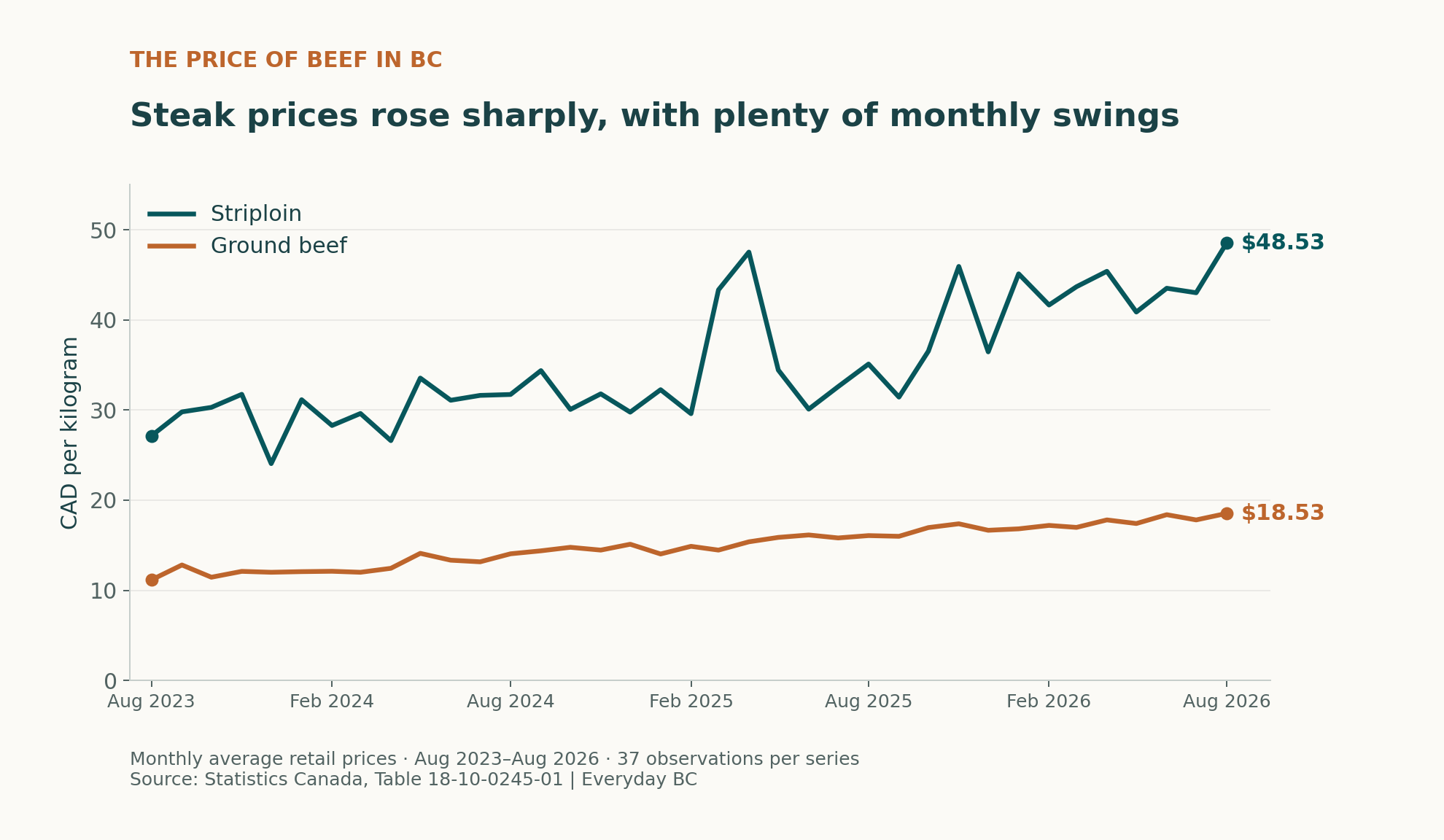
Striploin prices fluctuated sharply between months, while ground beef followed a steadier upward path. The 78.7% figure compares the two August endpoints; it is not an annual rate of increase.
| Product | August 2023 | August 2026 | Three-year change |
|---|---|---|---|
| Beef striploin cuts, per kg | CAD27.15 | CAD48.53 | +78.7% |
| Ground beef, per kg | CAD11.16 | CAD18.53 | +66.0% |
These figures measure beef sold in BC, regardless of origin. The 78.7% increase applies specifically to striploin cuts, rather than beef as a whole.
Drought can affect supply long after the weather improves
An important part of the story is the number of cattle on farms.
Statistics Canada reported that the national cattle herd declined for a third consecutive January in 2025. Breeding beef cow numbers were also down 1.2% from January 2024. The agency linked the smaller decline that year to improvements in western Canadian feed and drought conditions.[2]
Cattle need pasture, water and feed. When dry conditions make those harder to secure, maintaining or expanding a herd becomes more difficult.
Fewer breeding cows also limit the number of calves that can enter future production. Better weather does not immediately restore the breeding herd, so difficult conditions can affect beef supply years later.
A BC price tag is connected to demand beyond Canada
Tight supply is only part of the equation. Demand matters too.
In its August 2025 farm-price release, Statistics Canada identified tight North American feeder-cattle supplies and strong demand for beef and veal as factors supporting cattle prices. That month, slaughter-cattle prices in BC increased 3.5% from July.[3]
These are prices received by farmers, rather than supermarket prices, but they show pressure further up the supply chain.
Statistics Canada also attributed record cattle prices in the first half of 2026 to continued strong global demand for beef and live animals.[7] Even when BC shoppers choose Canadian beef, the price is connected to supply and demand across North America and beyond.
Is most of the beef we eat Canadian?
Yes, nationally—but imports are a substantial part of the picture.
Canada Beef’s 2024–2025 annual report, citing Canfax, puts imported beef at 25.36% of Canadian consumption in 2024. That implies a domestic share of approximately 74.64%.[4]
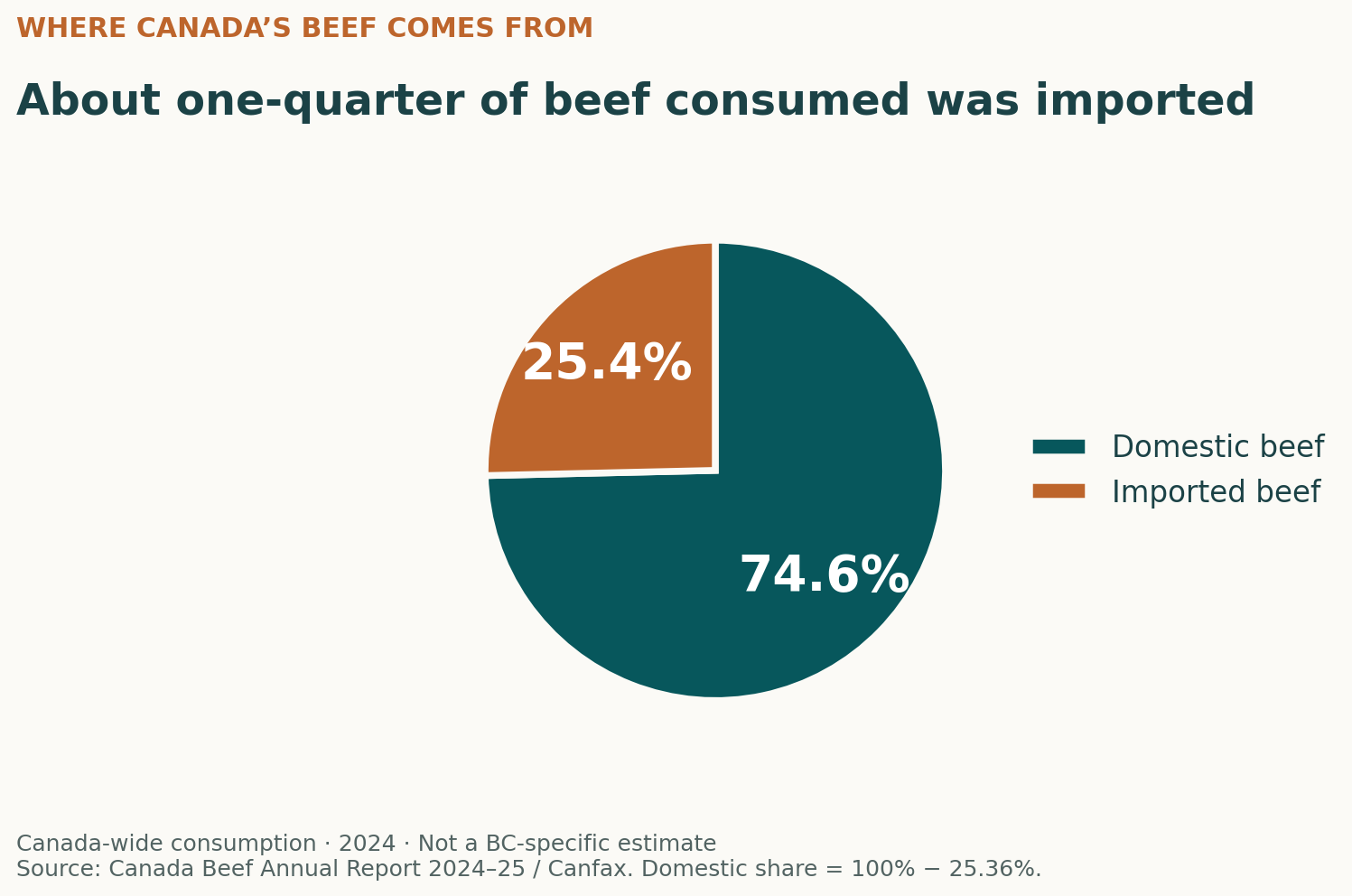
Approximately three-quarters domestic and one-quarter imported. These are Canada-wide consumption figures for 2024, not a BC-specific estimate. Domestic share is calculated as 100% minus the reported import share. Source: Canada Beef / Canfax.[4]
Canada is also a major exporter. The Canadian Cattle Association reports that 54% of production was exported in 2025, including live cattle exports.[5]
That export percentage is based on production, while the pie chart is based on domestic consumption. They use different denominators.
This trade structure means Canadian beef remains connected to international markets. Export customers seek supply alongside domestic buyers, while imported beef is exposed to production conditions elsewhere.
Why not simply raise more cattle?
Higher prices can encourage producers to expand. However, beef supply responds slowly. The Alberta Beef Cow-Calf Manual describes a lag of approximately two to three years between an expansion decision and additional production reaching the market.[6]
Producers need breeding females, calves must be born, and those calves need time to grow. Keeping females for breeding also means they are not immediately available for meat production. Building tomorrow’s supply can therefore constrain what is available today. Higher prices cannot produce a sudden increase in beef on supermarket shelves.
When might beef prices settle down?
Canadian producers are retaining more cattle for breeding. In July 2026, beef heifers for breeding were up 5.7% from a year earlier, while beef cow numbers increased 1.9%. However, cattle and calf slaughter in the first half of the year fell 4.6%.[7]
A recovery in supply would not guarantee lower prices. If global demand remains strong, it could absorb additional production and continue to support prices.
The increase in breeding cattle is an encouraging sign. Whether BC shoppers see cheaper beef will depend on how much room recovering production creates between available supply and demand—both at home and abroad.
About the data: Average retail prices can change with product mix and quality as well as prices. The 78.7% figure compares average prices; it is not a CPI measure of pure inflation. These data also cannot establish how much of the increase was caused by each market factor.[1]