How Expensive Is Canadian Chicken Breast?
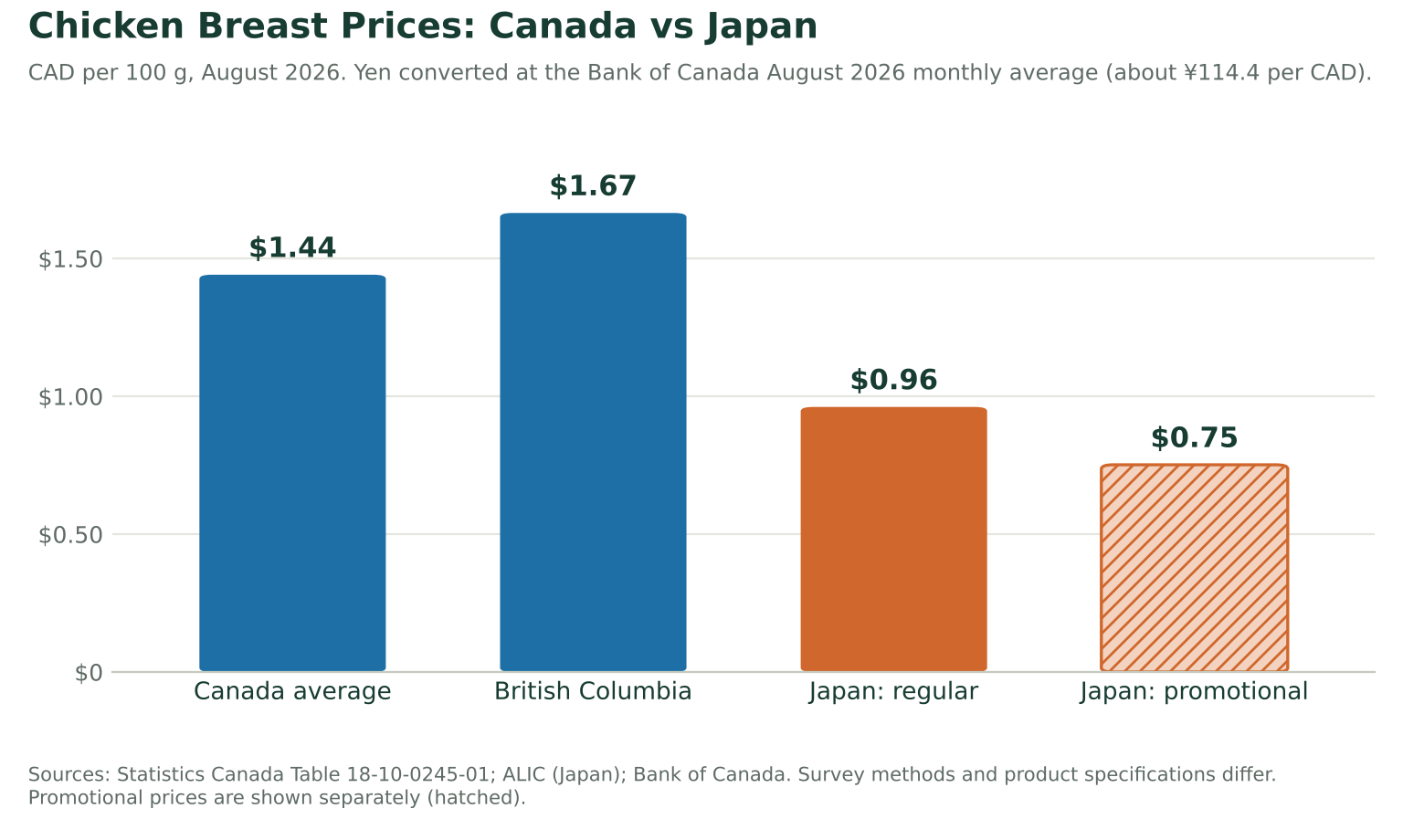
In August 2026, chicken breasts cost an average of CAD14.41 per kilogram across Canada and CAD16.65 in British Columbia. That works out to approximately CAD1.44 and CAD1.67 per 100 grams.
Japan’s Agriculture & Livestock Industries Corporation (ALIC) reported a regular retail price of ¥110 per 100 grams that month, with a promotional price of ¥86. Converted at the Bank of Canada’s August 2026 monthly average exchange rate (¥1 = CAD0.00874, or about ¥114.4 per Canadian dollar), Japan’s regular price equals about CAD0.96 per 100 grams, while its promotional price is about CAD0.75. On that basis, BC’s price is about 1.7 times Japan’s regular price, and the Canadian average is about 1.5 times.
This is an indicative comparison rather than an exact like-for-like measurement. The exchange rate is a monthly average, not the rate you would get when exchanging money or paying by card, and survey methods and product specifications, including skin-on or skinless preparation, may differ. Japan’s promotional price should also be distinguished from its regular price.
Canadian Demand Gives Breast Meat a Higher Value
Canadian consumers have traditionally favoured white meat, including chicken breast. A 2024 USDA report described fresh boneless, skinless breast as Canada’s most expensive chicken cut, widely used in restaurants and popular for barbecuing. It also noted growing demand for dark meat, including boneless thighs.
Japan has a different balance of demand. ALIC explains that consumers’ stronger preference for thigh meat helps keep thigh wholesale prices above breast prices. Its August 2026 retail survey recorded regular prices of ¥159 per 100 grams for thighs, compared with ¥110 for breasts.
Every bird or animal yields its cuts in fixed proportions, so producers cannot simply raise more of the popular one. When demand concentrates on one cut, that cut tends to become more expensive while the others become relatively cheaper. Trade can sometimes even out these differences, but as the sections below explain, chicken imports into Canada are limited by quotas. That helps explain why chicken breast developed a reputation as a budget ingredient in Japan while attracting a higher price in Canada.
Roughly Nine-Tenths of Canada’s Chicken Supply Is Domestic
Canada relies primarily on domestic production for its chicken supply. According to an analysis published by Farm Credit Canada (FCC) in February 2026, imports account for approximately 11% of domestic chicken supply, a share that has remained relatively stable in recent years. Broadly speaking, that means roughly nine-tenths is domestically supplied and one-tenth is imported.
These figures cover chicken overall, rather than breast meat specifically. They are also a description from FCC’s early-2026 outlook, rather than a final result for the full year. Imports supplement Canadian production, but domestic producers remain the main source of supply. This makes domestic production conditions and the rules governing supply particularly relevant to the market.
Cheaper Imports Face Limits
Canada’s chicken sector operates under supply management. The system combines production controls, producer-pricing mechanisms and import controls to match supply with demand and support stable returns for farmers.
Imports are managed through tariff-rate quotas. Imports within the permitted access can receive lower-duty treatment, while substantially higher duties apply outside that access. Canada’s 2026 tariff schedule lists an over-quota duty of 249%, subject to a minimum of CAD6.74 per kilogram, for fresh or chilled boneless chicken under the relevant classification.
That rate does not apply to all imported chicken. Nor does it mean that a 249% surcharge is added to domestically produced chicken. Instead, the system limits competition from additional low-cost imports. When demand rises, the market cannot simply respond by bringing in unlimited quantities of cheaper overseas chicken to push supermarket prices down.
These restrictions help explain the market structure, although the sources used here do not establish how much of the Canada–Japan retail price gap they explain.
Higher Beef Prices Add Demand for Chicken
Recent price pressures also involve competition between different meats. In its February 2026 outlook, FCC noted that higher beef prices were encouraging consumers to switch to chicken, increasing demand.
FCC also observed that farmgate and retail prices do not always move together. Processing, distribution and retail factors may therefore contribute to supermarket prices alongside farm production costs. High chicken breast prices cannot be attributed to feed costs or farm prices alone.
Why the Price Gap Exists
Canada combines strong demand for breast meat with a predominantly domestic supply and limits on competition from cheaper imports. Higher beef prices have recently added to demand for chicken overall, and processing, distribution and retail factors may also affect supermarket prices. Japan’s stronger preference for thighs helps make breast meat relatively inexpensive.
Together, these differences help explain why the same cut occupies a different price category in each country. Chicken breast’s reputation as a cheap ingredient depends on what consumers prefer and how the market supplies it.