Why prices are falling
In September 2026, benchmark prices in the Greater Vancouver REALTORS® (GVR) area were $1,784,700 for detached homes (down 7.3% from a year earlier), $1,016,700 for townhouses (down 4.7%) and $682,500 for apartments (down 6.2%). Sales were 25% below the 10-year average, and the number of homes for sale was 24% above the long-term average. The ratio of sales to active listings was 10.9%; when it stays below 12%, prices tend to come under downward pressure.
Interest rates are only part of the story.
First, population growth slowed sharply. According to the Bank of Canada, the net number of newcomers to Canada dropped from 1.4 million in 2023 to under 300,000 in the year from the fourth quarter of 2024 to the third quarter of 2025, after changes to immigration policy. The source doesn't break the figure down. One of the main supports for housing demand has weakened.
Second, investors have pulled back. Buying a condo before it's built and selling once it has gone up no longer pays, and some new units now sell below their presale price. The Bank of Canada found that in Toronto, presales collapsed and condo starts fell to lows not seen since the 1990s.
Third, supply doesn't match demand. The 2021–22 building boom added mostly small units. In Toronto, an estimated 60% of new condos are very small units, while only about 30% of new households fit that profile. In Vancouver, too, the drop in sales in September 2026 came mainly from apartments.
And rates have stopped falling. The Bank of Canada cut its policy rate to 2.25% on October 29, 2025, and has held it there through its September 2026 meeting. Even so, uncertainty over trade with the US, job losses and slow income growth have kept buyers away. CMHC notes that improved affordability alone hasn't been enough to bring many buyers back.
What kept prices rising for 40 years
Two strong tailwinds pushed Canadian home prices up over the past four decades.
The first was falling interest rates. The big banks' posted 5-year mortgage rate was around 20% in the early 1980s. Posted rates sit above what borrowers actually pay, but by 2020–21 the 5-year fixed rates people actually got sometimes dipped below 2%. When rates fall, the same monthly payment supports a bigger mortgage, and prices rise to match. With the policy rate at 2.25%, there's far less room for rates to fall than there was 40 years ago, so that tailwind can't blow the same way again.
The second was fast population growth. That has now reversed too.
CMHC also expects Vancouver's average price to fall in 2026 and rise only modestly in 2027 and 2028. The era when buying meant prices would rise on their own looks unlikely to return, at least for now.
Comparing the monthly costs
Let's run the numbers. Take an apartment at the $682,500 benchmark price, bought with 20% down ($136,500) at 4.49% over 25 years. That rate is the Bank of Canada's average for new fixed mortgages of 5 years or more with 20% or more down (July 2026).
| Cost | Buying (first month) | Renting |
|---|---|---|
| Mortgage payment | $3,019 | ― |
| Property tax (0.3% of value a year) | $171 | ― |
| Maintenance (0.5% of value a year) | $284 | ― |
| Strata fee | $500 | ― |
| Insurance | $50 | $20 |
| Rent | ― | $2,750 |
| Total | $4,024 | $2,770 |
Buying costs about $1,254 more a month. But about $995 of the mortgage payment repays principal. It still leaves your bank account, but it stays with you as equity in the home. Counting only the costs you don't get back (interest, property tax, maintenance, strata and insurance), buying costs about $3,029 a month and renting $2,770.
Buying also takes a lot of cash up front. On top of the down payment, there's $11,650 in BC property transfer tax and about $2,500 in legal and other closing costs, about $150,650 in all. First-time buyers who qualify are exempt from $8,000 of it, bringing the tax down to $3,650.
To get the mortgage, you also have to pass the stress test: you must be able to afford payments at the higher of 5.25% or your rate plus 2 points. At 4.49%, that's 6.49%. A simple estimate, with housing costs at 39% of income, puts the household income needed for this apartment at roughly $128,000. Other debts and how each lender counts strata fees and heating change that, so treat it as a rough guide.
Who has more after 10 years?
Here's how the comparison works. Both people start with the same $150,650 or so and can afford the same monthly housing spending. The buyer uses that money for the down payment, transfer tax and legal costs. The renter invests the same $150,650.
As the table above shows, the buyer spends about $1,254 more each month, and that includes the principal part of the mortgage payment. So the renter invests that difference every month, as if paying the same as the buyer. On the buyer's side, the principal repaid counts as equity in the home.
After 10 years, the buyer's wealth is what they'd keep if they sold: the sale price minus the remaining mortgage and selling costs. The renter's wealth is the investment portfolio. These are the assumptions, the same as the calculator's starting values below.
| Assumption | Value |
|---|---|
| Home price | $682,500 |
| Down payment | 20% ($136,500) |
| Costs when buying | $11,650 transfer tax, about $2,500 legal and other costs |
| Mortgage | 4.49% over 25 years, same rate after each renewal |
| Property tax and maintenance | 0.3% and 0.5% of the home's value a year (rising with the value) |
| Strata and insurance | $500 and $50 a month (renter's insurance $20) |
| Home price growth | 2% a year |
| Rent | $2,750 a month (close to Vancouver's $2,741 average asking rent for all units), assumed to rise 2.3% every year, the same as the 2026 cap |
| Investment return | 5% a year, before tax (as in a TFSA) |
| Costs when selling | 3.5% of the sale price |
| Tax on the gain from selling | None (principal residence) |
If home prices rise 2% a year, the buyer has about $406,900 after 10 years and the renter about $403,200, a difference of about $3,600. That's close to a tie.
Here's the breakdown by year. The monthly gap narrows because rent rises while the mortgage payment stays the same, but the renter still spends less for all 10 years.
| Year | Home value | Mortgage left | Selling costs | Buyer's wealth | Renter's wealth | Monthly gap (first month of year) |
|---|---|---|---|---|---|---|
| 1 | $696,150 | $533,816 | $24,365 | $137,969 | $173,622 | $1,254 |
| 3 | $724,274 | $507,762 | $25,350 | $191,163 | $221,030 | $1,144 |
| 5 | $753,535 | $479,289 | $26,374 | $247,873 | $270,447 | $1,030 |
| 7 | $783,978 | $448,171 | $27,439 | $308,367 | $321,945 | $909 |
| 10 | $831,964 | $395,994 | $29,119 | $406,851 | $403,248 | $718 |
The calculation runs month by month. Rent rises 2.3% at the start of each year (assuming the 2026 cap continues), property tax and maintenance follow the home's value each month, and strata and insurance stay the same. Canadian fixed-rate mortgages are compounded semi-annually by law, which gives a payment of $3,019 a month (compounding monthly would give about $3,032).
Because the gap is small, a small change in the assumptions can flip the result, as the comparisons below show.
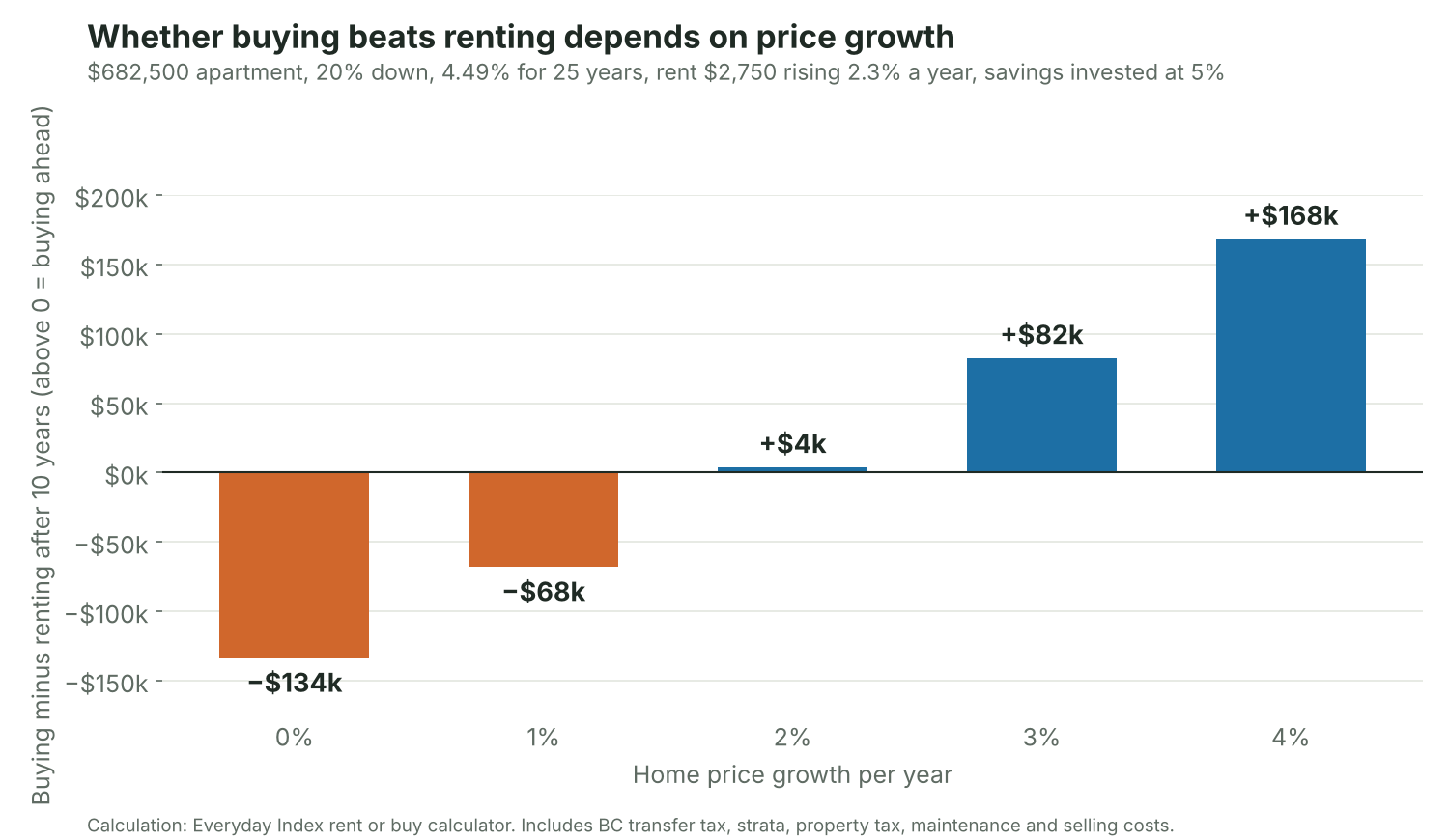
Price growth matters most. If prices rise 3% a year, buying comes out about $82,000 ahead. If prices don't rise at all for 10 years, renting comes out about $134,000 ahead.
The rent and how long you stay matter too.
| Change (everything else as above) | After 10 years |
|---|---|
| Rent of $2,373 (Vancouver average asking rent, 1-bedroom) | Renting ahead by about $60,400 |
| Rent of $3,271 (Vancouver average asking rent, 2-bedroom) | Buying ahead by about $92,100 |
| Staying 5 years | Renting ahead by about $22,600 |
| Staying 20 years | Buying ahead by about $104,200 |
| Rate of 3.86% (average variable) | Buying ahead by about $41,500 |
| Investment return of 7% a year | Renting ahead by about $66,000 |
The asking rents are Rentals.ca and Urbanation's averages for units listed in the city of Vancouver in September 2026. They show what a new tenancy costs, not the average rent sitting tenants actually pay.
Short stays tend to favour renting because the transfer tax and selling costs weigh heavily. If you bought and sold right away at the same price, the costs of buying ($14,150 in transfer tax and legal costs) and selling (about $23,900) alone would come to about $38,000. It takes time to earn that back.
What the numbers don't show
Some things aren't captured by the calculation.
Owning has real advantages. There's no tax on the gain when you sell your home (the principal residence exemption). Mortgage payments are forced savings, which matters more than it sounds, because few renters actually invest the difference every month. And because you buy with borrowed money, even a small rise in price is a large gain on your down payment. The same works in reverse when prices fall.
On the other hand, your rate can go up when you renew, typically every 5 years. This calculation assumes the same rate for the whole period.
Renting gives you the freedom to move and no repair bills. In BC, rent increases for tenants who stay in the same home are capped, at 2.3% in 2026. But there's no cap on the rent for a new tenancy, and a landlord can still end a tenancy for their own use.
Run your own numbers
Enter the home price, your down payment and the rent, and the calculator shows which comes out ahead and by how much. The mortgage rate is filled in from the Bank of Canada's latest average for new mortgages, and switches to the insured rate when you put down less than 20%. You can also type your own rate. The calculator works out BC property transfer tax, the first-time buyer exemption, CMHC insurance and the income needed for the stress test.
Loading the Rent or buy calculator…
The same calculator is also on our rent or buy calculator page.
From investment to home
In BC today, buying a home is no longer an investment that's sure to go up. The tailwinds of the past 40 years, falling rates and fast population growth, can't be counted on anymore. For a benchmark apartment at today's rents and rates, buying and renting come out roughly even.
Still, in this calculation, buying was more likely to come out ahead if you stay a long time and would otherwise pay relatively high rent. What matters is the price you pay, how long you stay, and how much you expect prices to rise. Whether to buy or rent is now less about predicting the market and more about how you want to live.
This article is general information, not financial or real estate advice. The calculation is a simplified estimate; actual results depend on the home, rates and taxes.