How much have prices actually gone up?
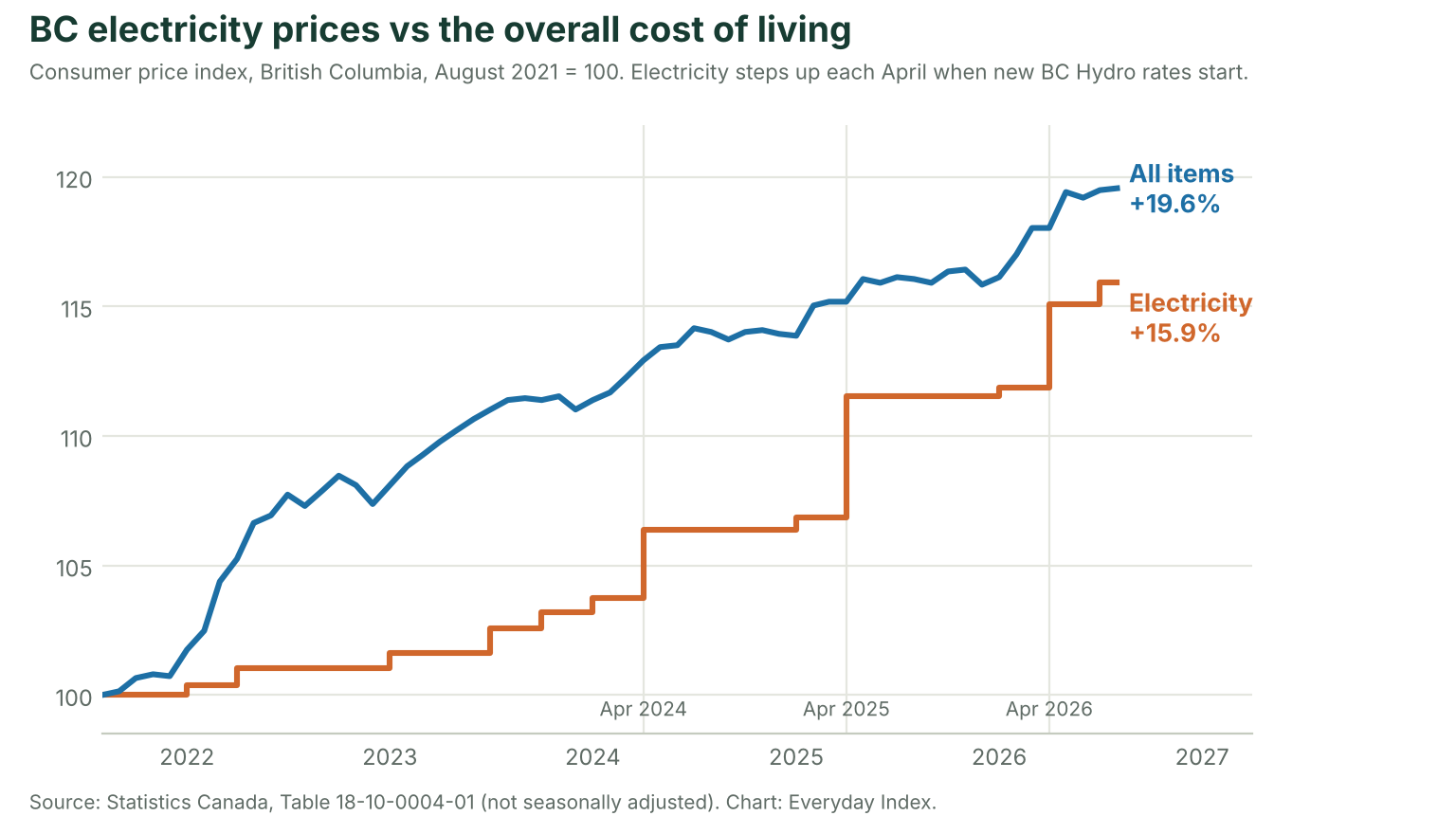
Statistics Canada's consumer price index puts the increase at 4.0% over the year to August 2026, and 15.9% over five years.
That sounds like a lot until you compare it with everything else. BC's all-items index rose 19.6% over the same five years. Electricity did get more expensive, but groceries, rent and many other costs climbed faster.
What's different about electricity is the timing. It doesn't drift up month by month the way food prices do. It jumps once a year, in April, when BC Hydro's new rates take effect. The index rose 2.5% from March to April 2024, 4.4% in 2025 and 2.9% in 2026. For the rest of the year it barely moves.
Two years of 3.75% increases
In March 2025, the province directed the BC Utilities Commission to set BC Hydro's average rate increase at 3.75% a year for two years. The increases took effect on April 1, 2025, and April 1, 2026. They cover BC Hydro's 2026 and 2027 fiscal years, which end in March 2027.
The government's figure for an average residential customer is about $100 a month, so each increase works out to roughly $3.75 a month. The province also says the increases will stay below cumulative inflation for seven years in a row.
What happens from April 2027 hasn't been announced yet.
So why are rates going up?
There isn't a single cause. Several costs are landing at the same time.
Drought and imported power
BC runs mostly on hydro, which means the weather matters more than most people realize. After two years of below-average rain and snow, the dams couldn't produce enough, and BC Hydro had to buy power from outside the province.
Business in Vancouver, citing filings with the BC Utilities Commission, reported that imports reached almost 25% of BC Hydro's needs: about 13,600 GWh over 12 months, at a cost of roughly $1.38 billion, mostly from the United States and Alberta. The Globe and Mail reported that in the first half of fiscal 2023/24 alone, BC Hydro added $463 million to a deferral account, mainly because of those imports.
The deferral account is worth understanding. Instead of passing a sudden cost straight on to customers, the utility records it and recovers it gradually over later years. It smooths the bill, but it doesn't make the cost disappear. It's closer to carrying a balance: you still pay it off later, through your rates. Those balances reach the bill through the deferral account rate rider, a percentage BC Hydro applies to the charges and resets each year. It can be positive or negative. On my own bill for July to September 2026 it was −1.5%, a small credit.
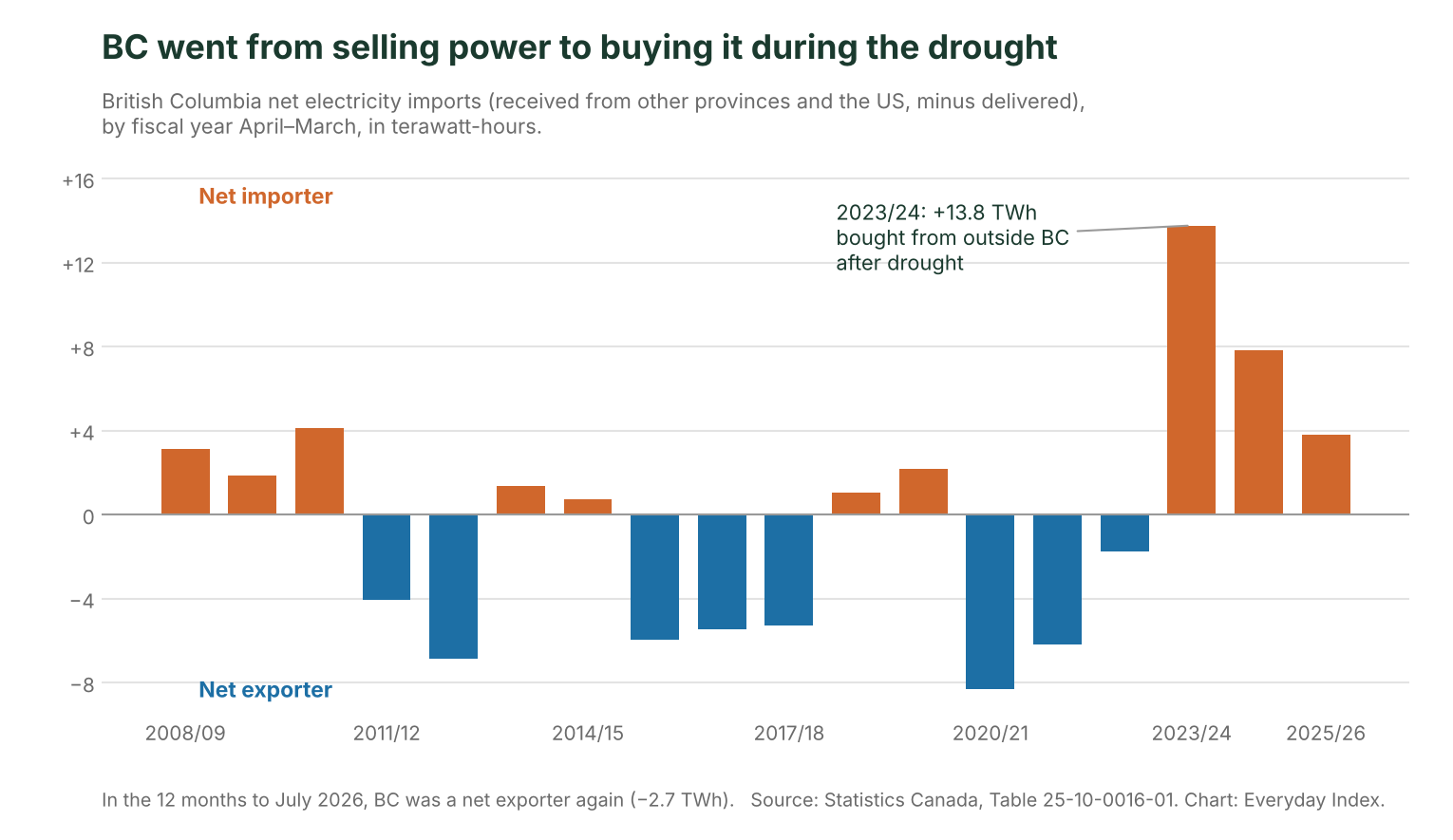
Statistics Canada's figures tell the same story. BC often sells more electricity to its neighbours than it buys; in fiscal 2020/21 it sold 8.3 TWh more than it bought. In fiscal 2023/24 (April to March) that flipped, and BC bought 13.8 TWh more than it sold. Net purchases fell to 7.8 TWh in 2024/25 and 3.8 TWh in 2025/26, and in the 12 months to July 2026 BC was a net exporter again.
New supply and infrastructure
The province also points to the Site C dam on the Peace River coming into service, along with wider spending on generation and the grid. Site C is expected to add about 8% to BC's generation. Dams and power lines are paid for over decades, and part of that cost shows up in rates every year.
Growing demand
BC Hydro expects electricity demand to grow about 15% by 2030. There are more people, and more homes, vehicles and industries are switching to electricity.
General inflation
And like every other business, BC Hydro is paying more for labour, equipment and materials.
For all that, BC still compares well. In a 2024 Hydro-Québec comparison cited by the province, BC Hydro's rates were the third lowest of 22 utilities.
Reading the bill
Most homes are on the tiered rate. The bill has two parts: a basic charge you pay every day no matter what, and an energy charge for the electricity you use.
Basic charge: 23.44 cents per day
Tier 1: 11.87 cents per kWh, for the first 22.1918 kWh per day of the billing period
Tier 2: 14.08 cents per kWh for anything above that
The Tier 1 allowance is set per day, so it grows with the length of the billing period. Many homes are billed about every two months, and some monthly. On a 60-day bill, the first 1,331.5 kWh are charged at the Tier 1 rate. That's one reason two bills for similar usage can look different: one period may simply be a few days longer.
GST of 5% goes on top. BC's provincial sales tax hasn't applied to electricity since April 1, 2019.
Two examples
A small apartment using 700 kWh over 60 days never leaves Tier 1:
Basic charge: 60 days × $0.2344 = $14.06
Energy: 700 kWh × $0.1187 = $83.09
Total: $97.15 before tax, about $102 with GST
A house with electric heat using 2,400 kWh over the same 60 days goes well into Tier 2:
Basic charge: $14.06
First 1,331.5 kWh × $0.1187 = $158.05
Remaining 1,068.5 kWh × $0.1408 = $150.44
Total: $322.55 before tax, about $339 with GST
Both are worked out from the published rates. A real bill has a couple more lines. Mine for July 21 to September 17, 2026 covered 546 kWh over 59 days: a basic charge of $13.83 and Tier 1 energy of $64.81, exactly as the rates predict. Then came the deferral account rate rider of −1.5% (−$1.18) and a regional transit levy of $3.68 (59 days × $0.0624), which applies only to homes in Metro Vancouver. GST of 5% on $81.14 brought the total to $85.20. You can try your own numbers in the bill calculator on our Electricity page.
Other ways to pay
Since April 1, 2025, homes have had options besides the tiered rate.
Flat rate
Every kWh costs 12.70 cents, plus a basic charge of 25.00 cents a day. Because Tier 1 is cheaper than that, the flat rate only pays off if you use a lot. On a 60-day bill the break-even point is around 2,200 kWh, or about 37 kWh a day. BC Hydro suggests it for electrically heated detached homes, townhomes and duplexes. In the house example above, it would come to $319.80 before tax, a little under the $322.55 on the tiered rate. A small saving, and only for heavy users.
Time-of-day pricing
If you have a connected smart meter, you can add time-of-day pricing to either plan. Electricity used between 11 p.m. and 7 a.m. is 5 cents per kWh cheaper; electricity used between 4 and 9 p.m. costs 5 cents more. Running the dishwasher or charging an electric vehicle overnight helps. Doing laundry and cooking dinner at 6 p.m. works against you.
Equal Payment Plan
This one doesn't change the price at all. You pay the same amount each month, based on your last 12 months of use, and BC Hydro settles up once a year. If winter bills are the problem, it spreads them out.
The bottom line: bills keep rising, but more slowly than prices overall
Bills are going up for a mix of reasons: expensive power bought in during the drought, a large build-out led by Site C, and demand that keeps growing. The 3.75% increases in 2025 and 2026 add about $3.75 a month for an average household.
Over five years, though, electricity (+15.9%) has risen less than the cost of living overall (+19.6%), and BC's rates are still among the lowest in North America. I wouldn't read that as a sign that bills will level off. With demand and investment both still rising, another increase each April is the safer assumption.
For most households, the bigger lever isn't the rate. It's how much electricity you use, and when. If you heat with electricity, run the numbers on the flat rate. If you can shift use to late evening, time-of-day pricing may help. And if it's the winter bills that hurt, the Equal Payment Plan at least makes them predictable.
Next, I'll compare BC's electricity bills with Japan's at the same monthly usage, and look at why BC comes out so much cheaper.