If prices are falling, now may look like a good time to buy.
But buying a home means paying mortgage interest, plus strata fees, property tax and repairs. If you keep renting, on the other hand, you can invest the down payment you would have spent on the purchase.
So if you plan to stay for the next 10 years, which option leaves you with more money?
We ran the numbers using Greater Vancouver home prices and September 2026 asking rents.
Home prices are falling
According to Greater Vancouver REALTORS®, the benchmark prices in September 2026 were as follows.
| Home type | Benchmark price | Year over year |
|---|---|---|
| All homes | $1,075,900 | −5.5% |
| Detached | $1,784,700 | −7.3% |
| Townhouse | $1,016,700 | −4.7% |
| Condo | $682,500 | −6.2% |
The condo market is especially weak. Condo sales in September were 777, down 18.6% from a year earlier.
Even so, buying a home priced at $680,000 or more still takes a large down payment and a sizeable mortgage.
What does it cost to rent right now?
To compare buying with renting, we want to use current asking rents.
The average rents published by CMHC include long-term tenants who have lived in their homes for years. That can make them different from what a new tenant pays.
This time we use the September 2026 asking rents from Rentals.ca and Urbanation.
| Area | 1-bedroom | 2-bedroom |
|---|---|---|
| Burnaby | $2,111 | $2,785 |
| Vancouver | $2,373 | $3,271 |
Even within Burnaby, a 1-bedroom and a 2-bedroom differ by $674 a month.
When comparing with buying, which rent you use matters a great deal.
The Greater Vancouver condo benchmark price of $682,500 is not limited to any number of bedrooms. So it can't be directly compared with 2-bedroom rent to conclude that buying wins for the same home.
Instead, we fix the purchase price at $682,500 and look at how the result changes with the rent. The base case uses the Burnaby 2-bedroom asking rent of $2,785, and we also compare it with the 1-bedroom rent of $2,111 in the same area.
Vancouver city rents are shown above, but because they don't match the area of the purchase price, we left them out of the wealth comparison.
Note that the purchase price for Burnaby is also the Greater Vancouver benchmark. This calculation does not compare identical homes. It is a simulation of how the level of rent affects how much wealth you build.
What if you buy a $682,500 condo?
We compare buying a resale condo with continuing to rent.
| Base assumptions | Setting |
|---|---|
| Condo purchase price | $682,500 |
| Down payment (20%) | $136,500 |
| Mortgage | $546,000 |
| Mortgage interest rate | 4.49% |
| Amortization period | 25 years |
| Monthly mortgage payment | About $3,019 |
| Rent in the base case | $2,785 a month |
| Rent in the comparison case | $2,111 a month |
| Annual rent increase | 2.3% |
| Annual home price growth | 2% |
| Annual investment return | 5% |
| Comparison period | 10 years |
The 4.49% rate is an assumption for comparison. We use semi-annual compounding, which is common for fixed-rate mortgages in Canada, and assume the same rate for the full 10 years.
In reality, the interest rate may change when the mortgage is renewed.
Costs other than the mortgage
| Cost | Per month |
|---|---|
| Strata fee | $450 |
| Property tax | $250 |
| Home insurance | $100 |
| Reserve for repairs and special levies | $150 |
| Total | $950 |
We assume these ownership costs rise 2% a year.
Together with the mortgage payment, housing costs in the first year of owning are about $3,969 a month. On top of that, buying involves Property Transfer Tax of $11,650 and about $2,000 in legal and registration fees.
Adding the down payment and these costs, the cash needed up front is about $150,150.
When you sell after 10 years, we assume costs such as agent commissions of 3.4% of the sale price.
These are assumptions for comparison. Actual ownership and selling costs vary by property.
Mortgage interest comes to about $212,000 over 10 years
The monthly mortgage payment is about $3,019. Over 10 years, total payments come to about $362,000.
Of that, about $212,000 is interest, and only about $150,000 goes toward the principal.
That means that even after 10 years in the home, about $396,000 of the mortgage remains. You often hear people say, "Rent is money thrown away, so you should buy."
But mortgage interest, strata fees, property tax and selling costs are, for the most part, money you don't get back either.
Not every dollar of the mortgage payment becomes your own wealth.
Who comes out with more money after 10 years?
If home prices rise 2% a year, the $682,500 condo would be worth about $832,000 after 10 years.
After subtracting selling costs and the remaining mortgage, the buyer is left with about $408,000.
If you keep renting instead, you invest $150,150, the equivalent of the down payment and the upfront costs of buying. We also assume you invest the monthly difference in housing costs.
We assumed an investment return of 5% a year.
| Net worth after 10 years | Amount |
|---|---|
| Buy | $407,683 |
| Rent and invest ($2,785 a month) | $400,688 |
| Rent and invest ($2,111 a month) | $515,792 |
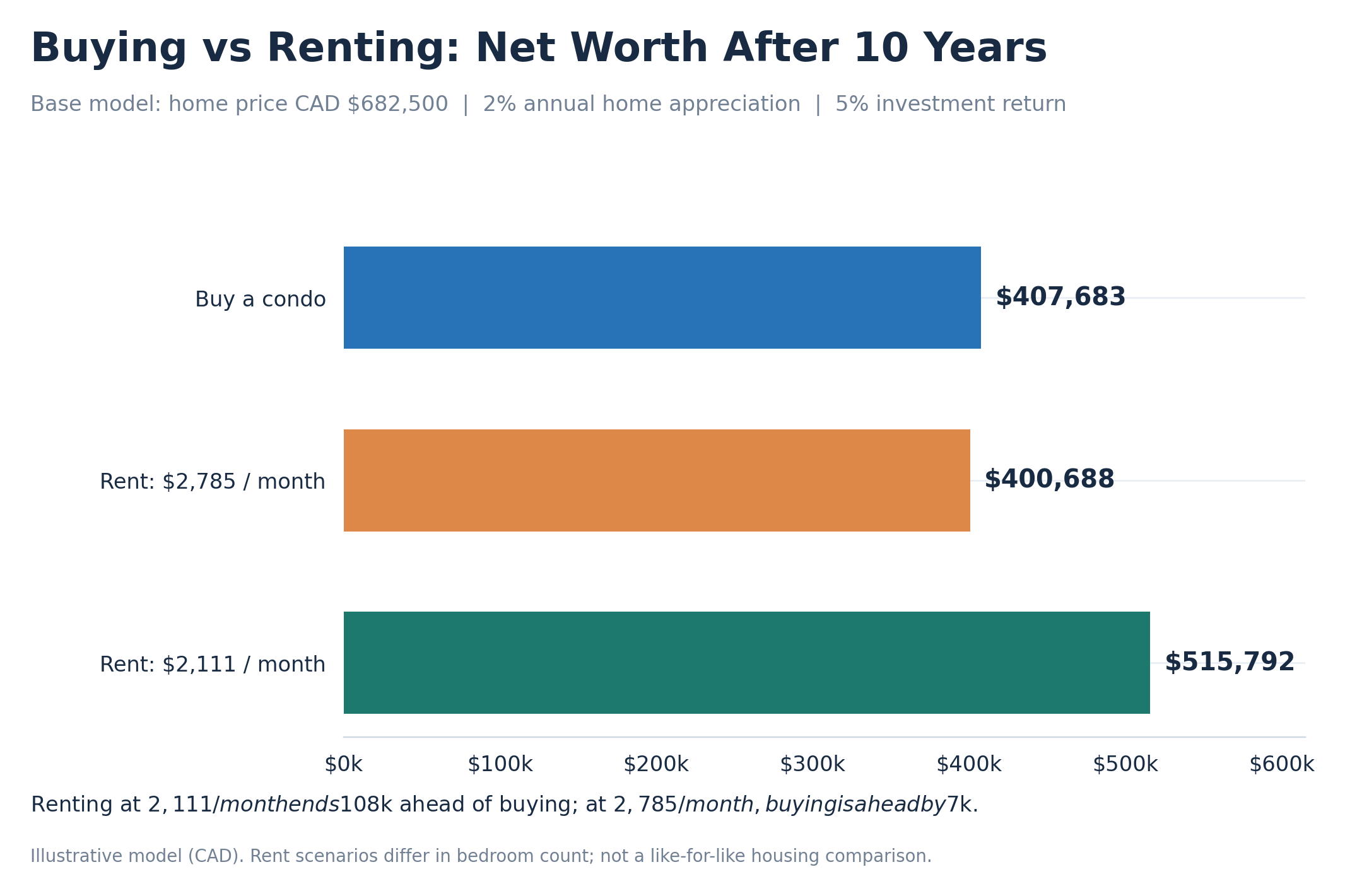
If rent is $2,785 a month, buying comes out about $7,000 ahead.
But if rent is $2,111, renting comes out about $108,000 ahead.
The difference in rent alone reversed the result. Of course, a 1-bedroom and a 2-bedroom also differ in size and comfort. What we show here is not a comparison of identical homes, but how the level of rent affects the wealth you build.
Taxes are lower for first-time buyers
BC has a Property Transfer Tax exemption for people buying their first home.
Since April 2024, a qualifying buyer who purchases a home priced above $500,000 and up to $835,000 is exempt from $8,000 of Property Transfer Tax on the first $500,000. For the $682,500 resale condo in this example, the tax falls from $11,650 to $3,650.
That does not mean the Property Transfer Tax is fully waived for homes up to $835,000.
The exemption has conditions, such as being a Canadian citizen or permanent resident, meeting the BC residency and tax-filing requirements, never having owned a principal residence anywhere in the world, and using the property as your home.
With this exemption, if rent is $2,785, buying comes out about $20,000 ahead after 10 years. If rent is $2,111, renting still comes out about $95,000 ahead even with the exemption.
The first-time buyer tax break matters, but it does not by itself make buying the winner.
New homes have a separate Property Transfer Tax exemption. This model assumes the purchase of a resale condo.
What if home prices don't rise?
So far we have assumed home prices rise 2% a year. But will prices really keep rising for the next 10 years?
Home prices move with interest rates, population growth, housing supply, incomes and more. So we changed only the rate of home price growth.
| Annual price growth | Rent $2,785 | Rent $2,111 |
|---|---|---|
| 0% | Renting +$137,000 | Renting +$252,000 |
| 1% | Renting +$68,000 | Renting +$184,000 |
| 2% | Buying +$7,000 | Renting +$108,000 |
| 3% | Buying +$89,000 | Renting +$26,000 |
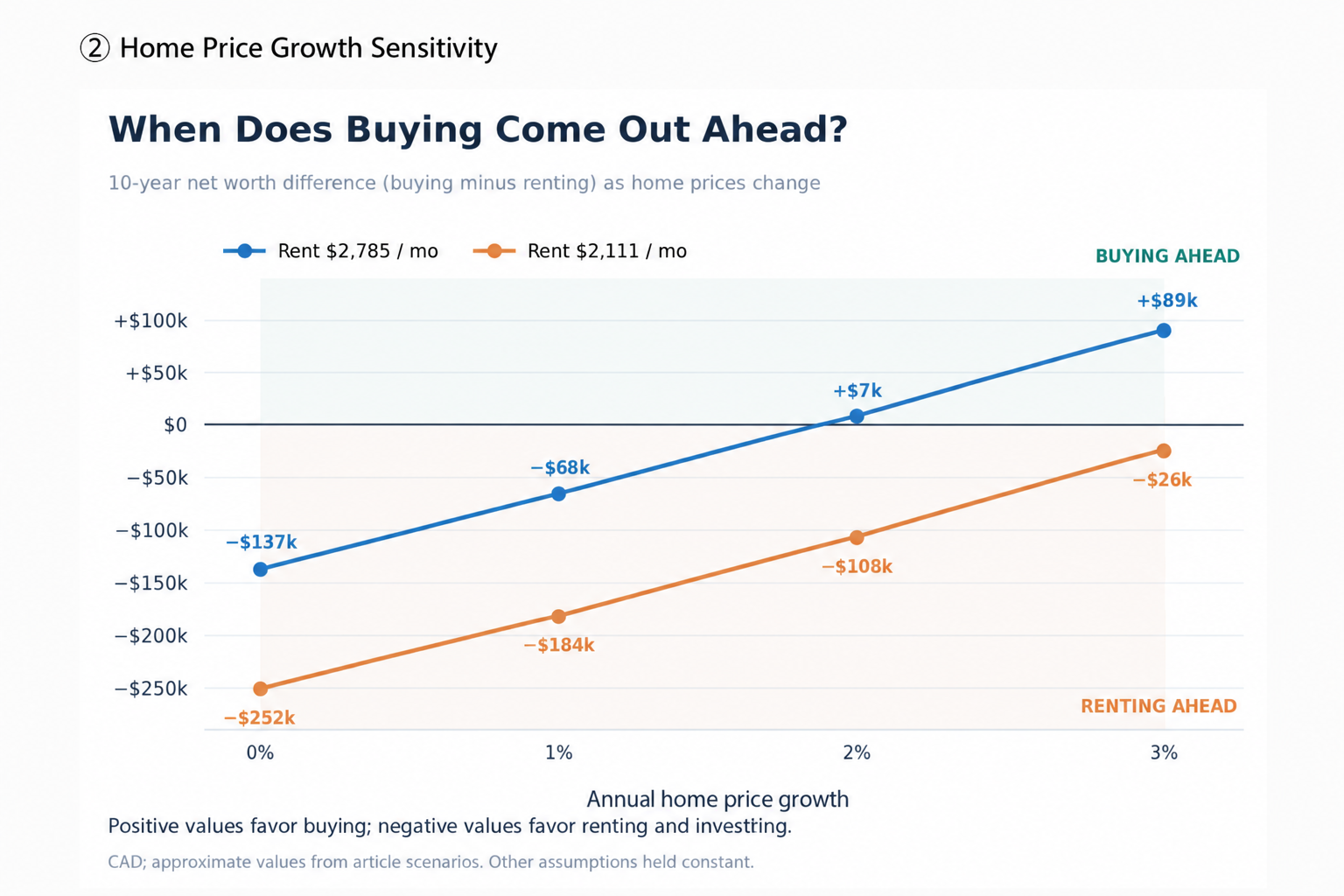
In this chart, the blue line is for $2,785 rent and the orange line is for $2,111 rent.
The blue line crosses zero at around 2% annual price growth. In other words, under these conditions, prices rising about 1.9% a year is the break-even point between buying and renting.
The orange line, on the other hand, stays below zero even at 3% growth. With rent at $2,111 a month, renting and investing comes out about $26,000 ahead even if prices rise 3% every year.
Whether prices rise 1% or 3% a year makes a big difference on its own.
However, there is no guarantee that home prices will rise 2% or 3% a year over the next 10 years.
The housing market also faces factors that are different from before, such as slower population growth, buyers' ability to pay and the supply of condos. If you buy, you need to plan for the case where prices don't rise.
What if investments return 7%?
Now we raise the renter's investment return from 5% to 7% a year and keep everything else the same.
In the base case with $2,785 rent, the investment portfolio after 10 years is about $474,000. Compared with the buyer's roughly $408,000, renting is about $66,000 ahead.
With $2,111 rent, there is even more to invest, so renting is further ahead. Of course, a 7% return is not guaranteed, and stock markets carry the risk of falling prices.
Taxes also deserve attention. Gains on the sale of your home are generally tax-free if you meet the Principal Residence Exemption requirements. Investment income in a taxable account, however, is taxed.
A TFSA is generally tax-free, but contribution room is limited. With an RRSP, you also need to consider the tax when you withdraw.
This comparison does not include taxes on investment income or management fees.
It also depends on how long you stay
People say the longer you stay in a home, the more buying pays off. Is that true?
Using the base-case rent of $2,785, we compared staying 5, 10 and 20 years.
| Length of stay | Which comes out ahead |
|---|---|
| 5 years | Renting by about $19,000 |
| 10 years | Buying by about $7,000 |
| 20 years | Buying by about $91,000 |
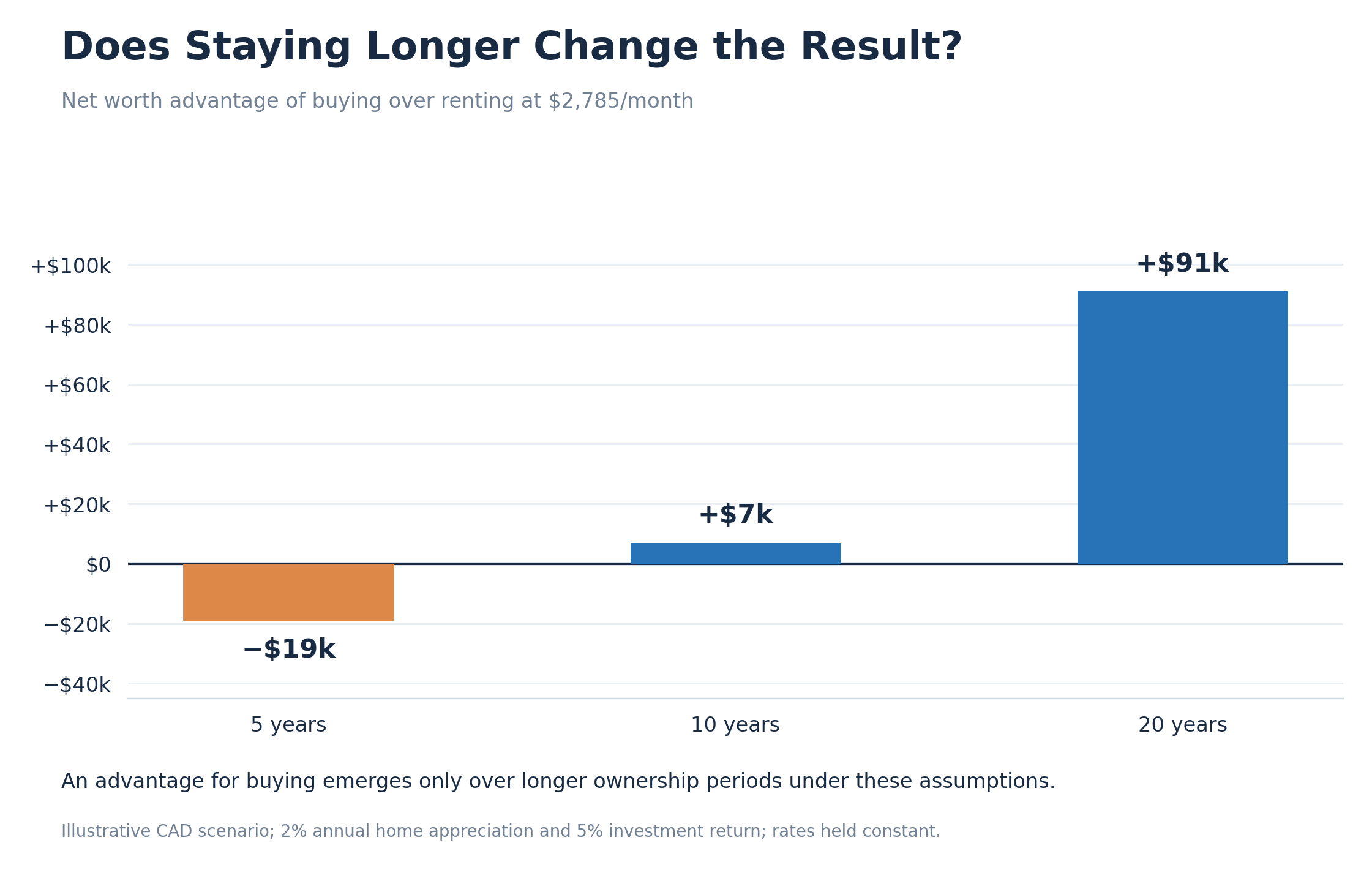
If you sell after 5 years, renting comes out about $19,000 ahead.
At 10 years the result flips, and buying is about $7,000 ahead. If you stay 20 years, the advantage of buying grows larger.
Buying involves large costs at purchase and at sale, so selling after a short time is a heavy burden.
On the other hand, the longer you stay, the more of the mortgage principal you pay down, and if home prices rise, the value of the home grows.
However, if rent is lower, these results also shift in favour of renting. And there is no guarantee that home prices, interest rates and investment returns over 20 years will follow fixed assumptions.
What about your situation?
In the calculations so far, we used a home price of $682,500, a mortgage rate of 4.49% and rent of $2,785 as the base case.
But the conditions when you actually buy differ from person to person.
Some people put down more, and some buy a condo with high strata fees. Others pay relatively low rent now and have no plans to move.
So we have prepared a simulator where you can change the home price, rent, mortgage rate, future home price growth and more.
Loading the Rent vs. Buy Calculator…
Main inputs you can change:
- Home Purchase Price
- Down Payment
- Mortgage Interest Rate
- Monthly Rent
- Monthly Ownership Costs
- Annual Home Price Growth
- Annual Investment Return
- Years of Ownership
- First-Time Buyer Exemption
The results show your net worth if you buy, your wealth if you rent and invest, and the difference between the two.
It's worth trying not only cases where home prices rise, but also cases where they stay flat or fall.
Note: The simulator is a tool for changing the comparison conditions. It does not predict future home prices or investment returns.
Is owning still worth it?
Owning a home has value that money alone can't measure.
In your own home, the risk of being asked to leave at a landlord's convenience is relatively small, and it is easier to secure a place to live for the long term. You also have the freedom to change the interior and fixtures to your taste.
Renting, on the other hand, offers the ease of moving, and you avoid directly bearing falling home prices or the cost of major building repairs.
For condos in particular, future increases in strata fees and special levies are hard to predict. Before buying, check the building's repair history and the state of its contingency reserve fund.
If your job or family situation may change, the flexibility of renting also has value.
Cheaper homes don't always mean buying is the better deal
In this estimate, with rent at $2,785 a month, the wealth difference between buying and renting after 10 years was about $7,000.
But with rent at $2,111 a month, renting comes out about $108,000 ahead.
And if home prices rise only 1% a year, renting comes out ahead even in the base case. If they rise 3% a year, the advantage of buying grows.
Home prices, rent, mortgage rates, investment returns, ownership costs and length of stay. Whether buying or renting pays off changes with all of these conditions. To compare accurately, you would need to look at homes in the same area, of the same size and with the same features.
Owning a home brings the value of stability in your life. But that alone does not make it the financially better choice.
With home prices falling in Greater Vancouver, you may find properties that are easier to buy than before.
Still, home prices having fallen and buying being the financially better choice are two different things.
If you're thinking of buying, run the numbers first, including the case where home prices don't rise as much as you expect.