Yet Statistics Canada's data tells a surprising story. Canada's price index for cellular services fell 52.8% from 2017 to 2025. While food, rent and many other things have become more expensive, cell phone service has become much cheaper.
So is Canadian cell phone service no longer expensive? And why was it so expensive in the first place? I looked at government statistics and telecom market data to find out.
In 2019, $30 a month bought 1GB
In 2019, a plan with 1GB of data could cost around $30 a month in Canada. This is not just my personal memory. According to the CRTC, Canada's telecom regulator, the average price of a 1GB mobile plan in 2019 was $29.03 a month. Even that was 25.8% lower than the year before. In 2018, the average was $39.10.
At the time, 1GB was not much data. Watching videos or downloading large files on the go could quickly bring you close to the limit. Today, plans with tens of gigabytes are available for around $30 a month, so the same budget buys far more data. Prices and plan details still vary by carrier, contract terms, promotions and region.
The cellular services price index fell 52.8% in eight years
According to Statistics Canada's telecommunications statistics, the price index for cellular services fell from 100 in 2017 to 47.2 in 2025, a drop of 52.8% over eight years. Over the same period, Canada's overall consumer price index rose from 100 to 125.9. While prices as a whole rose 25.9%, the cellular services price index fell by more than half.
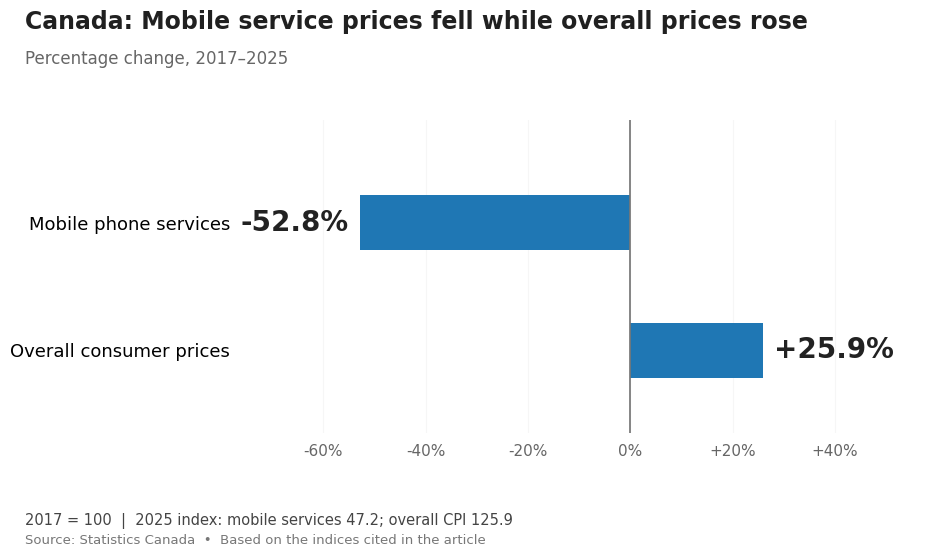
Cellular services price index and consumer price index in Canada (2017–2025)
This does not mean that everyone's monthly phone bill has been cut in half. The cellular services price index measures changes in the price of services such as calls, text messages and mobile data, so what the plan includes matters as much as the monthly price.
For example, suppose a plan that used to give 5GB for $50 a month now gives 50GB for the same $50. The monthly payment has not changed, but you can use ten times as much data. So even when the price index for telecom services falls, it is hard to feel that things have become cheaper if the actual bill stays the same.
From 2024 to 2025, the cellular services price index fell again, from 48.0 to 47.2, a further decline of about 1.7%.
Still, Canada's prices are high by international standards
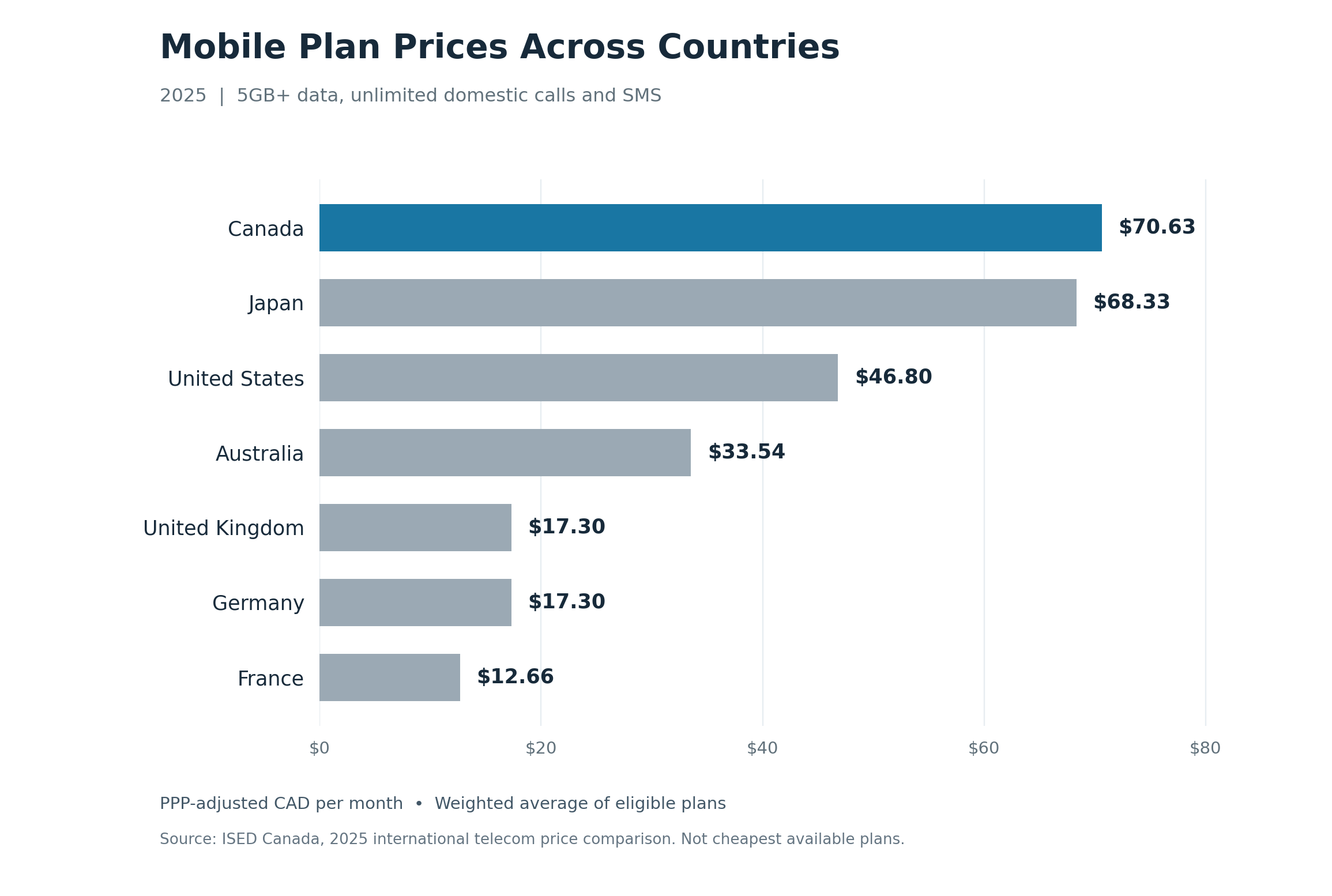
The price index for mobile services has fallen. Compared with plans in other countries, however, Canada's prices remain high. Let's look at the 2025 international telecom price comparison published by Innovation, Science and Economic Development Canada (ISED).
For plans with unlimited national calls and texts and at least 5GB of data, the average price in each country was as follows.
International mobile price comparison: average price of plans with 5GB or more (2025)
Prices are weighted averages converted to Canadian dollars at purchasing power parity (PPP) and include taxes. The comparison covers plans defined in the study as including unlimited national calls and texts and at least 5GB of data; it does not show each country's cheapest price or what users actually pay on average. The source is ISED's 2025 international telecom price comparison study (published in May 2026).
In this comparison, Canada's $70.63 is about 4.1 times the UK price and about 5.6 times the French price. Japan, at $68.33, is at almost the same level as Canada. Japan also has low-cost SIM plans, but this table does not compare budget plans alone, so the picture for each country can change depending on the plans and conditions covered.
The same study found that the lowest price for a qualifying plan in Canada was $30.45. Relatively cheap options do exist, but the average price of qualifying plans remains high.
Cheaper over the long term, but up in the 2025 price survey
There is another interesting figure. In the ISED study, the average price of qualifying plans with 5GB or more in Canada rose from $63.80 in 2024 to $70.63 in 2025, an increase of 10.7%.
At first glance, this seems to contradict the roughly 1.7% decline in Statistics Canada's cellular services price index in the same year. But the two statistics measure different things. Statistics Canada's CPI continuously tracks price changes for the mobile services consumers use. ISED's international comparison, on the other hand, collects plans that meet certain conditions and compares their prices.
Because the mix of plans and the way prices are averaged also differ, one statistic can show a decline while the other shows an increase. The fact that Canadian cell phone service has become cheaper over the long term and the fact that the average price of plans on sale today is high do not necessarily contradict each other.
Why was cell phone service in Canada so expensive?
There are several reasons why cell phone service in Canada has been expensive. The most important are the concentration of the market among the big carriers and the conditions new carriers face when entering the market.
Reason 1: Rogers, Bell and TELUS hold about 90% of the market
Canada's main mobile carriers are Rogers, Bell and TELUS. According to the CRTC's 2026 Communications Market Report, these three carriers still held about 90% of the national mobile market as of 2024.
At first glance, Canada seems to have many more carriers. There are budget brands such as Fido, Chatr, Virgin Plus, Lucky Mobile, Koodo and Public Mobile. In reality, however, many of these brands belong to the big carriers.
Big carrier Main budget brands
Rogers Fido, Chatr
Bell Virgin Plus, Lucky Mobile
TELUS Koodo, Public Mobile
Even if their plans and sales methods differ, these are not all independent companies competing with one another. By running several brands within the same group, a carrier can attract a wide range of customers, from those who care most about price to those who care most about service.
At the same time, in a market with few independent competitors, price competition may not work well enough. The CRTC has also raised concerns about the market power the big carriers hold in Canada's mobile market. That said, market concentration alone cannot explain all of the high prices; the cost of network investment and the state of competition in each region also play a part.
Reason 2: It was hard for low-cost SIM providers to enter the market
In Japan, low-cost SIM services offered by MVNOs are widely known. An MVNO is a provider that offers service by renting an existing carrier's network instead of building its own cell towers across the country. Because it does not need to make a large investment in infrastructure from the start, it is one way for a new company to enter the market.
Canada also has MVNOs and budget brands, but there were limits on the rules for using the big carriers' networks. In 2021, the CRTC introduced an MVNO framework that allows regional carriers to use the big carriers' networks under certain conditions, to encourage competition. However, this framework does not let anyone freely rent the big carriers' networks.
Regional carriers that qualify must meet conditions such as holding spectrum licences. The framework is mainly designed to help regional carriers that have already invested in their own networks expand service into areas where they have not yet built one.
The CRTC wants both to encourage price competition and to make sure carriers keep investing in their networks. For that reason, it chose a framework that balances competition with network investment rather than simply increasing the number of low-cost SIM providers. These differences in regulation are likely one reason why independent low-cost carriers have been slow to grow in Canada.
Reason 3: The country is large, and networks are expensive
The size of the country is often cited as a reason for Canada's high telecom prices. The population is concentrated in cities and near the US border, but service must also reach sparsely populated areas. Carriers have to maintain cell towers and network equipment for a limited number of subscribers.
New technologies such as 5G also require investment. According to the CRTC's 2026 report, Canadian carriers have invested a cumulative $64.4 billion in their networks, including fixed and mobile, since 2020. This investment is a major cost for the telecom business.
The size of the country does not explain everything, however. In a 2021 policy decision, the CRTC acknowledged that network investment and spectrum purchases are costly, but it also concluded that there is market power in the mobile market that limits competition. In other words, what matters is not only Canada's geography but also how well competition is working.
Reason 4: Spectrum is expensive to acquire
To provide service, mobile carriers need radio spectrum. In Canada, spectrum licences are allocated through auctions and other processes, and carriers may pay large sums to acquire them. These acquisition costs are also part of the cost of running a telecom business.
That said, the relationship between high spectrum prices and high cell phone prices is not necessarily a simple one-way street. Auction prices also depend on how much revenue carriers expect to earn from the spectrum in the future. Network investment, spectrum costs and market competition all combine to set the price of mobile service.
So why has it become cheaper recently?
Behind the sharp drop in Canadian cell phone prices is a change in competition. Regional carriers such as Freedom Mobile have offered plans different from those of the big three. The CRTC's MVNO framework has also made it easier for qualifying regional carriers to expand their service areas.
In fact, according to the CRTC's 2026 report, more than 55% of new mobile subscribers added in 2024 went to new entrants and regional carriers. This shows that carriers other than the big three are gaining ground in subscriber growth.
Of course, the big three still hold about 90% of the market, and the market structure has not changed dramatically. Even so, the growth of regional carriers and the expansion of budget plans have created more choice than before.
It's cheaper, so why does it still feel expensive?
Looking into this, I noticed that there are two different ways to look at cell phone prices. One is how much cheaper service has become for what you get. The other is how much you actually pay each month.
For example, suppose a plan that used to give 5GB for $50 a month now gives 50GB for $50 a month. The price per gigabyte has dropped sharply, but you still pay the same $50 every month. And for someone who does not use much data, 50GB may simply be more than they need. Some people would rather see a lower monthly price than more data.
Statistics Canada's data shows a large drop in mobile service prices. Meanwhile, ISED's 2025 study found that the average price of qualifying plans with 5GB or more was $70.63, up 10.7% from $63.80 in 2024. The long-term decline is real, but that does not necessarily mean the burden on household budgets has become small enough.
Also, if you have been with the same carrier for years, you will not necessarily be moved to a newer plan automatically. Comparing current plans with your existing contract may help you lower your monthly bill.
More data, but what about the bill?
In 2019, plans offering 1GB for $30 a month were not unusual. In the years since, Canadian mobile service has changed a great deal. Statistics Canada's price index fell 52.8% from 2017 to 2025, and the same budget now buys more data than before.
On the other hand, the 2025 international price comparison found that the average price of qualifying plans in Canada was still high, close to Japan's level. Several factors lie behind Canada's high prices, including the concentration of the market among the big three, the conditions for independent carriers to enter, and the cost of networks and spectrum.
Competition from growing regional carriers and budget brands has recently increased choice, but the overall structure of the market has not changed much yet. Getting tens of gigabytes is not the same as getting a lower monthly bill.
Canadian cell phone service has certainly improved. Even so, for people who use only a little data, being able to choose a cheaper monthly plan may matter more than getting more data.