
Walking through downtown Vancouver, you notice the "For Lease" signs. New buildings are being completed, while long-standing offices and shops still have empty space. The downtown office vacancy rate, just 2.2% at the end of 2019, remains high at around 12% in 2026.
With so much more empty space, why haven't asking rents fallen much? In the office market, landlords sometimes keep the listed rent while offering a real discount in other forms, such as a period of free rent. For street-front shops, meanwhile, costs other than rent also make it hard to open. Using data up to October 2026, we look at what is happening downtown.
Office vacancy is more than five times pre-pandemic levels
At the end of 2019, the downtown Vancouver office vacancy rate was 2.2%. Demand was so strong that finding a large block of office space was difficult. CBRE's Q1 2026 data puts the rate at 12.3%, about 5.6 times the pre-pandemic level.
The chart below connects confirmed observation points from the same research firm. It does not show a value for every year from 2019 to 2023, so changes in between cannot be read from it.
In CBRE's Q1 2026 figures, downtown Vancouver's 12.3% is lower than downtown Toronto's 14.4% and the Canadian downtown average of 18.2%. Even so, it is a big change from 2.2% in 2019. Companies now have an easier time choosing offices, while landlords find it harder to secure tenants than before.
Recovery stalls in fall 2026: the latest Q3 data
In its Q3 report released on October 6, 2026, Colliers put the Downtown Core office vacancy rate at 12.2%, up 0.3 percentage points from the previous quarter. Meanwhile, vacancy in high-quality AAA/A-class buildings fell 0.1 points to 9.1%. Overall vacancy is roughly flat, but the gap between popular buildings and the rest is widening.
Note that Colliers' "Downtown Core" and CBRE's "Downtown" do not necessarily cover exactly the same area or use the same classifications. We cannot conclude that vacancy improved by 0.1 points from 12.3% to 12.2%. Here we keep CBRE's line chart as is and present Colliers' Q3 figures as separate information on the latest situation.
In Q3 2026, the story was less about big companies expanding and more about existing companies relocating and consolidating. According to BOMA BC, Amazon completed its move from TELUS Garden to The Post, returning about 148,000 square feet of its former offices to the market. Even when new buildings fill up, vacancy across the city does not necessarily fall by the same amount.
The empty space is mostly in older offices
Not every office is equally empty. In CBRE's Q1 2026 figures for Metro Vancouver, cited by BOMA BC, the vacancy rate for high-quality AAA/A-class buildings was 8.4%, compared with 18% for B/C-class buildings, more than twice as high. The chart below compares all of Metro Vancouver, not just downtown.
In Colliers' Q3 2026 data, AAA/A-class vacancy in the Downtown Core was 9.1%, while Class B recorded about 95,000 square feet of negative net absorption. The gap in demand between new and old buildings continues. However, the 8.4% and 9.1% figures come from different firms and cover different areas, so they should not be compared directly as a rise or fall.
With hybrid work now established, companies need less space than before and find it easier to move into newer buildings with better amenities and locations. BOMA BC's Q3 analysis found that about 75% of downtown leases over the past 12 months were for units under 5,000 square feet. Demand has not disappeared, but it has shifted from large expansions toward smaller units and higher-quality buildings.
Why are asking rents slow to fall when vacancy rises?
With more offices sitting empty, you might expect rents to fall. But the commercial real estate market is not that simple. BOMA BC's Q2 2026 market analysis reported that downtown office asking rents are not much different from 2020, although small declines have recently begun.
At the same time, landlords are offering generous incentives, such as Free Rent, where base rent is waived for a period, and a Tenant Improvement Allowance, where the landlord covers part of the fit-out cost. The rent shown in a listing can differ from what a tenant actually pays.
Rent stays at $35, but the real discount is 10%
If you lease 1,000 square feet of office space at $35 per square foot per year for five years, standard base rent is $35,000 a year, or $175,000 over five years. But if the first six months of base rent are free, you pay $157,500.
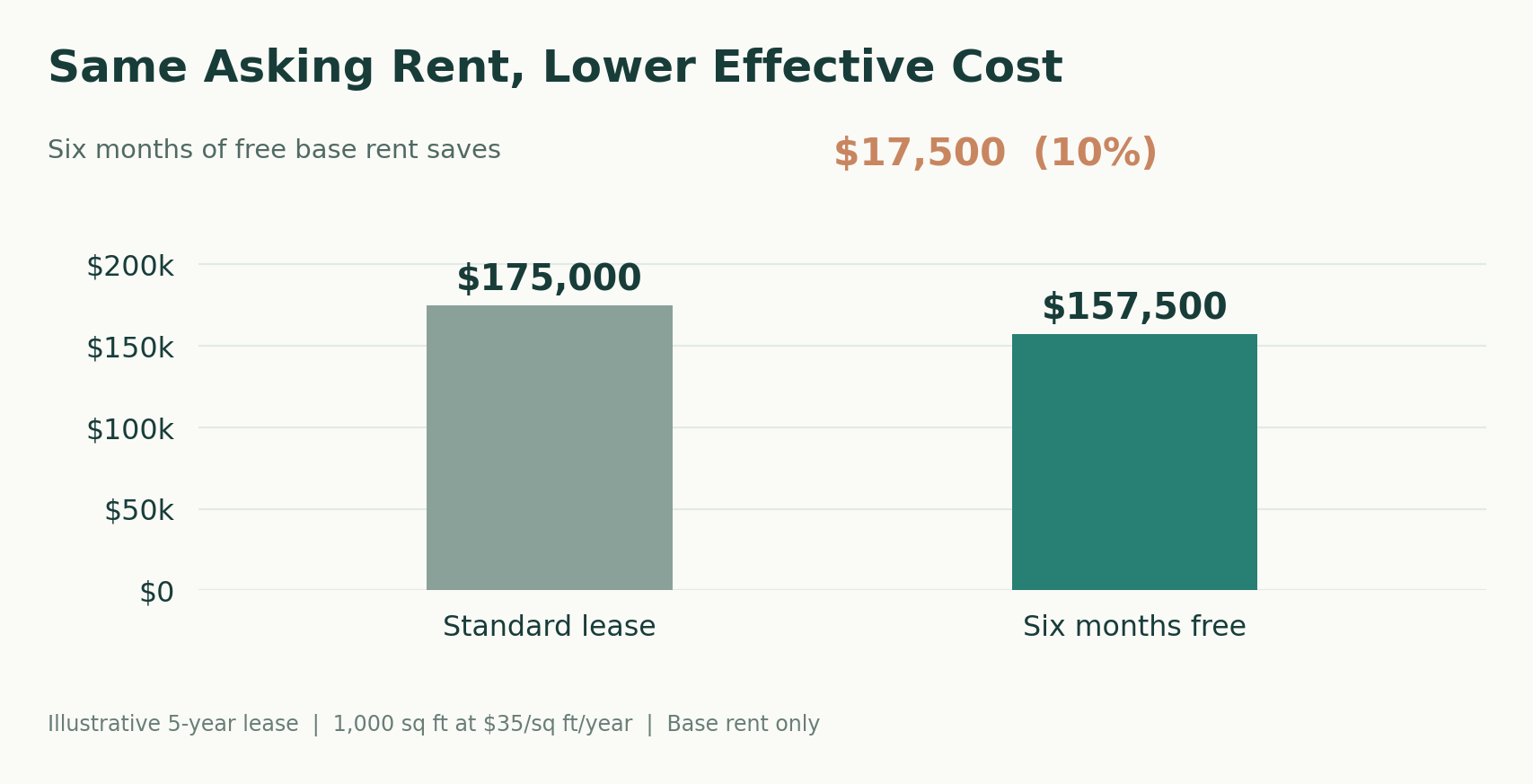
The effective discount on base rent is 10%, and the effective base rent works out to $31.50 per square foot per year. This is a hypothetical example to explain how it works, not Vancouver's average incentive. If taxes, common area costs and other Additional Rent are charged separately, the discount on the total payment is even smaller.
Why landlords don't want to cut the rent itself
One reason lies in how commercial property is valued. The value of an income property depends on the rent it will generate, so a long-term cut in base rent can affect the valuation, financing terms and negotiations with other tenants. With net operating income (NOI) of $1 million a year and a 5% capitalization rate (cap rate), a simple income valuation is $20 million. If NOI falls to $900,000, the same cap rate gives $18 million.
Actual appraisals also take free rent and tenant improvement allowances into account, so incentives do not make the economic cost disappear. Still, landlords have a reason to close deals with temporary incentives instead of cutting long-term base rent. When an existing tenant leaves, the landlord faces the cost of finding a new one and the lost rent while the space is empty, so businesses with leases up for renewal gain room to negotiate. That said, it depends on the renewal clauses and how popular the building is.
Empty storefronts are a different problem from offices
Empty offices are hard to see from the street, but storefronts keep their "For Lease" signs. According to Downtown Van's 2026 report, the storefront vacancy rate in January 2026 was 12.7% across the downtown district and 24.9% on Granville Street. On Granville Street, that means roughly one in four storefronts has no business operating in it.
This vacancy rate is based on whether a storefront is open for business. Storefronts that have already been leased but have not yet opened are counted as vacant. So the 24.9% does not mean that every one of those spaces is still looking for a tenant.
Still, Granville Street's vacancy rate improved from 29.4% in 2025 to 24.9% in January 2026. Across the downtown district, storefront vacancy fell from 14.9% the year before to 12.7%, and the number of businesses grew by a net 29 in 2025. The recovery is under way, but it varies widely by area.
Unlike offices, whether street-front shops fill up is not decided by rent alone. Fit-out costs, wages, supply prices, consumer spending, the surrounding environment and the property tax burden all affect business decisions.
A small café, taxed as if it were a high-rise site?
In BC, property assessments consider not only how land is used today but also its "Highest and Best Use." Even if a single-storey café stands on a site, the development potential can be reflected in the assessed value if a high-rise could be built there in the future. Many commercial leases also make the tenant pay the taxes and maintenance costs. The value of a tower that might be built someday can affect the operating costs of a shop selling cups of coffee.
Why the city reduces the tax burden
The City of Vancouver introduced the Development Potential Relief Program (DPRP) in 2023 for certain business properties whose land values have been pushed too high by development potential, and ran it again in 2026.
In 2026, a rate 50% lower than the city's general purpose tax rate for Class 5/6 applied to part of a qualifying property's assessed land value (20–30% depending on the area and zoning, up to $6.5 million). It does not cut the whole property tax bill in half. It does not apply to provincial School Tax, TransLink, Metro Vancouver or other taxes. There are also eligibility conditions, such as the property being occupied or in use as of the end of October of the previous year, so not every owner of an empty space can use it.
Tourists are back, but sales are not
In 2025, downtown hotel occupancy averaged 80.5%, back to pre-pandemic levels. Yet according to Downtown Van, average weekly sales in 2025 fell 1.65% year over year for retailers and 4.4% for restaurants. A recovery in tourism does not mean shops and restaurants recover in the same way.
In the visit data, Vancouver residents accounted for 45.7% of all visits but only 30.0% of actual visitors, which shows that locals come back again and again. Demand also differs between weekday visits for work or errands and weekend visits for fun. More tourists cannot simply replace the lunch demand that office workers once created every day.
Why lower rent does not fill storefronts
For a shop, a neighbourhood where customers and staff feel safe matters as much as rent. In Downtown Van's 2025 requests to its Community Safety Team, requests related to outdoor drug use rose 33% and wellness checks rose 26%, with an average of 50% concentrated on Granville Street. These figures show demand for safety responses, not the number of crimes. Cutting rent alone will not attract new tenants if the business outlook is unclear.
Housing is short, so why not turn empty offices into homes?
Calgary is promoting office conversions. According to the city's 2026 figures, 21 conversion projects totalling 2.68 million square feet have been approved for support, with plans that include 2,667 homes and 226 hotel rooms. That does not mean they have all been completed.
Vancouver, by contrast, has long maintained downtown as an employment centre. Converting offices to housing reduces the floor space available to businesses in the future. Homes also need windows, natural light, plumbing and exit routes, and if converting an office costs too much, the project may not pay off.
Does downtown need to go back to 2019?
In 2019, Vancouver's offices were almost full, and it was hard for companies to find space. In 2026, there are more options, and tenants can sometimes negotiate terms. But the Q3 figures show that demand is not coming back evenly. When companies move into new buildings, the buildings they leave behind are left with empty space.
Street-front shops showed signs of improvement in 2026, but Granville Street's vacancy rate is still high. And lowering rent alone does not solve the problems of wages, taxes and the surrounding environment.
A lower office vacancy rate is not necessarily the same as a downtown that is easy to run a business in and pleasant to visit. The challenge ahead is not returning to what the city looked like in 2019, but how it changes to fit the way people work and live today.