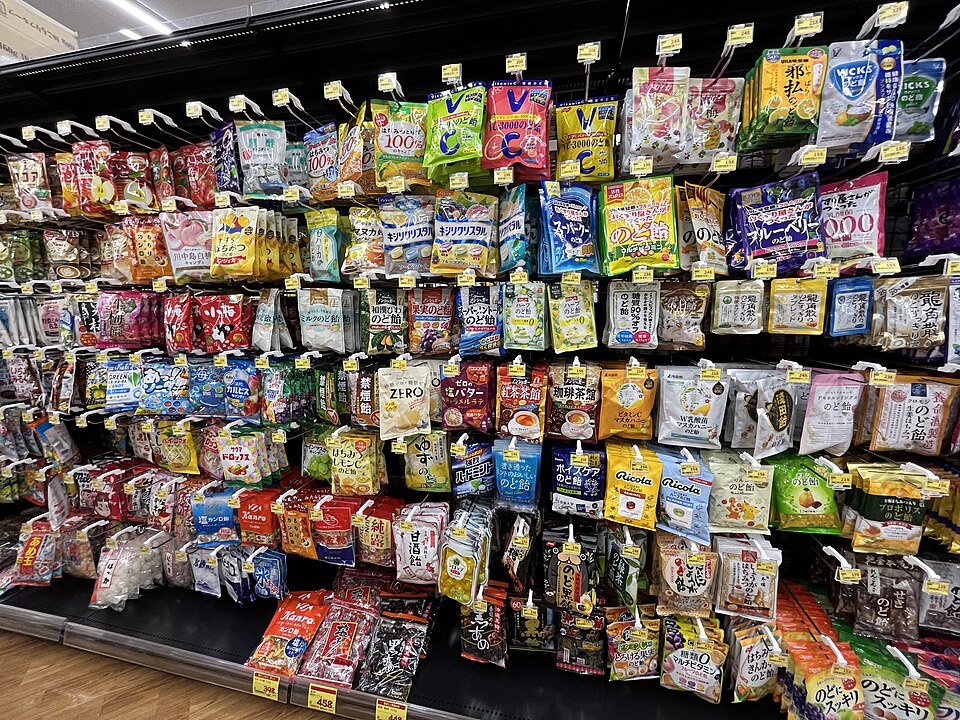
In Canadian supermarkets, on the other hand, the same kinds of products always seem to be on the shelves. New products do come out, of course, but not as often as in Japan, or so it feels.
Japan keeps launching new flavours, while in Canada the classics stay on sale for a long time. Is that really the difference? Or is it simply that Japan has a bigger population and a bigger snack market? Can numbers back up this impression? Using food market data published by the Canadian government, we compared the number of product launches in Japan and Canada.
Japan has about 2.2 times as many launches as Canada
The food market data from Mintel, published by Agriculture and Agri-Food Canada, records the number of product launches in Japan and Canada.
"Snacks" covers a wide range: chocolate, potato chips, cookies, candy and more. So here we compared "Sweet Biscuits / Cookies," a category common to both countries' statistics.
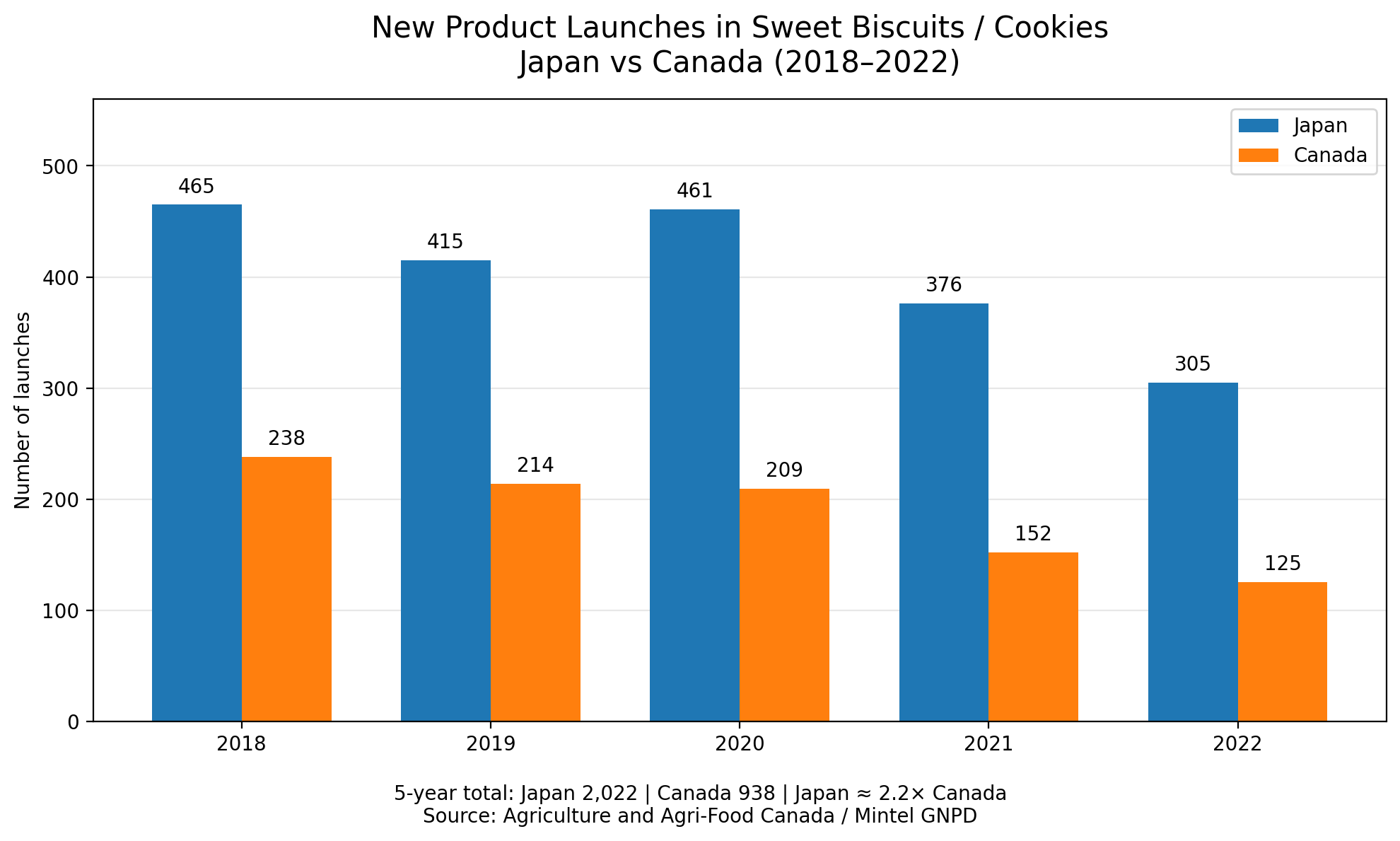
Over the five years from 2018 to 2022, 2,022 launches were recorded in Japan and 938 in Canada. Japan has about 2.2 times as many as Canada. On average, that is about 404 a year in Japan and about 188 in Canada. Japan had more in every one of the five years.
Comparing 2018 and 2022, though, launches fell in both countries. In Japan they dropped from 465 to 305, and in Canada from 238 to 125. This period includes the COVID-19 pandemic. However, this data alone can't tell us whether the decline came from COVID or from a change in companies' product development policies.
Also, the number of launches here is not the number of "new flavours." It includes entirely new products as well as new varieties of existing products, relaunches and packaging changes. Even so, Japan recorded more than twice as many product launches as Canada.
Per person, the result reverses
There is one more point we can't overlook. Roughly estimated for 2018 to 2022, Japan's population is about 125 million and Canada's is about 39 million. Japan is about 3.2 times larger than Canada.
Converted to launches per million people over the five years, Japan has about 16 and Canada about 24. Japan has more in total, but once population size is taken into account, the result reverses. Does that mean Canada is more active in developing new products? Not necessarily.
Launches per million people are a useful reference for taking market size into account, but they do not show what kinds of products actually line the shelves or how often consumers come across a new flavour. For example, if one product is launched nationwide, it is recorded as one launch in both Japan and Canada. How many stores carry it and for how long it is sold is a different matter.
In other words, the number of launches alone can't tell us how often a supermarket's snack aisle changes. So where does the impression of frequently seeing new flavours in Japanese stores come from?
In Japan, new varieties are added to existing products
Looking at how Japanese manufacturers roll out products, one characteristic stands out. In another Mintel study of bakery products in Japan, 11,389 launches were recorded from January 2018 to November 2023. Of those, 6,448, or about 57%, were "New Variety / Range Extension." That refers to launches such as adding a new variety to an existing product line.
For example, a new flavour added to a popular cookie, or a different kind of product released under an existing brand. However, this statistic includes not only cookies but also bread and sweet buns. It does not mean that all of the 57% are new flavours. Even so, among the Japanese bakery products surveyed, new varieties made up more than half of the launch categories.
For consumers, trying a product from an unfamiliar brand may take a little courage. But when a snack you always buy comes out in a new flavour, it's easy to pick up. For manufacturers, too, an already well-known brand can be used to introduce new products. This approach can be seen as one strategy for adding freshness to the shelves without changing the brand much.
Calbee's potato chips come in about 100 flavours a year
Let's look at a specific manufacturer. According to Calbee's official FAQ, its potato chips are sold in more than 50 flavours at any given time. Counting supermarket-only, convenience-store-only, limited-time, limited-quantity and regional editions together, about 100 flavours are released a year.
Not all 100 are flavours making their first appearance. They include classics and limited editions that are relaunched. Even so, it is interesting that a single brand offers about 100 flavours a year.
What's more, Japanese potato chips aren't the same everywhere in the country. Some products are regional, and some varieties are sold only at convenience stores. Just by visiting a different store from the supermarket you usually use, you may come across products you don't recognize. This way of selling may be one reason the snack aisles in Japan feel like they change so much.
Canada has new flavours too
Of course, new-flavour products are released in Canada as well. For example, in July 2025, Ruffles announced two limited-time flavours: "Spicy Garlic" and "Double Crunch Korean Sweet Chili." Adding new flavours to a classic brand is a method used in Canada too.
So what kinds of new products are actually launched in Canada? A Government of Canada report recorded 2,551 product launches in three categories (cookies, snack bars and fruit snacks) from 2018 to 2022. Of those, 889, or about 35%, were new varieties or range extensions. In Canada too, companies don't only launch new brands; they also expand the variety of existing products.
Note that Japan's 57% covers bakery products as a whole, including bread and sweet buns, while Canada's 35% covers cookies, snack bars and fruit snacks. Because what is counted differs, these percentages can't be compared directly.
It is interesting that retailers such as Loblaws, Walmart and Sobeys are among the top companies launching new products in Canada. Not only manufacturers but also supermarkets' private-label brands are introducing new products. For example, private-label brands like Loblaws' President's Choice and No Name are a familiar presence in Canada. In the 2023 cookie, snack bar and fruit snack market, private labels accounted for 13.0% of sales.
In other words, product development does happen in Canada, but it is not carried out only by the large snack makers. However, we could not find statistics that compare, under the same conditions, the number of new flavours released each year by Calbee and by major Canadian potato chip brands. Why Canadians feel there are fewer new flavours still needs further checking.
In Japan, seasonal products are part of the lineup
Japanese snacks give the impression of having many products that follow the seasons. Cherry blossom in spring, citrus in summer, chestnut and sweet potato in autumn. As the seasons change, so do product packaging and flavours.
In fact, in Mintel's study of bakery products in Japan, 1,297 launches were labelled "Seasonal" and 1,025 were labelled "Limited Edition" from January 2018 to November 2023. That is about 11% and about 9% of all launches, respectively. Some products carry both labels, so the two can't simply be added together.
Also, these are figures for Japanese bakery products as a whole, not a comparison with seasonal products in Canada. Even so, they show that seasonal and limited-edition sales are built into how products are made.
Canada has Halloween and Christmas products too. In autumn you also see pumpkin-spice products. Still, in Japan, products that put seasonal ingredients such as cherry blossom, chestnut and sweet potato front and centre stand out especially. These differences may have to do with a culture of enjoying seasonal ingredients and a sales strategy of getting people to try something new every year.
What's the benefit of launching new flavours one after another?
Why do manufacturers release so many different products in the first place? One possible reason is that it gives consumers a new reason to try a product. Long-selling classics are already well known. But to consumers they are also familiar.
When a new flavour appears, people who don't usually buy it may get curious, and people who used to eat it often may buy it again. Limited-time sales have their own character, too. When the sales period is limited, some people will think, "Let me try it while I can."
On the other hand, manufacturers incur costs for product development, packaging, production and inventory management. Releasing more new flavours doesn't necessarily mean more profit. Selling classics for a long time also has advantages, such as stable demand and efficient production. Frequently rotating new products versus selling popular products for a long time. It is probably not a question of which is better, but a difference in how manufacturers build their shelves.
So does Japan really have more new flavours?
In this study, the number of cookie and biscuit launches in Japan was about 2.2 times that of Canada over the five years from 2018 to 2022. But converted to launches per million people, Canada comes out higher.
In the first place, these statistics also include relaunches and packaging changes. Because they don't count only new flavours, this data can't tell us whether Japan releases more new flavours. On the other hand, in Japan Calbee offers about 100 potato chip flavours a year, and many seasonal products and new varieties of existing products are launched as well.
Beyond differences in population and market size, seasonal product lineups and the strategy of adding new flavours to classic brands may also shape the impression of the shelves. The sense of frequently seeing new flavours in Japanese supermarkets can't be explained by the simple number of launches alone.
Not only how many products are launched, but where they are sold, how long they stay on the shelf and when they are swapped out. The real difference may lie in how products are sold.