How much you can put in
Each year you get new RRSP contribution room equal to 18% of your earned income from the year before, up to a dollar limit. For 2026, that limit on new room is $33,810; for 2027, it will be $35,390. What you can actually contribute also includes any unused room carried forward from earlier years. If you belong to a workplace pension plan, your new room is reduced by a pension adjustment.
Someone who earned $80,000 in 2025, with no workplace pension, gets $14,400 of new room for 2026. You only reach the $33,810 limit with earned income of about $188,000 or more.
Room you don't use isn't lost. It carries forward with no expiry, so someone who never contributed in their twenties can still use that room later. Your current limit appears on your Notice of Assessment and in CRA My Account.
Contributions for the 2026 tax year can be made until March 1, 2027, the 60th day of the following year. If you're 18 or older, you can usually go over your limit by up to $2,000 without the excess contribution tax, although that amount can't be deducted at the time. Excess contributions beyond the $2,000 are generally taxed at 1% a month.
How the deduction works on your tax return
An RRSP contribution is deducted from your income on line 20800 of your return. It doesn't reduce your tax by a flat percentage. It lowers your taxable income, so the refund is roughly your contribution multiplied by your marginal tax rate, the rate on your last dollars of income.
In BC in 2026, the combined federal and provincial marginal rates are:
$25,570 to $44,952: depends on your tax credits (the BC tax reduction phase-out can raise the rate by about 3.56 points)
$44,953 to $50,363: 19.6%
$50,364 to $58,523: 21.7%
$58,524 to $100,728: 28.2%
$100,729 to $115,648: 31.0%
$115,649 to $117,045: 32.79%
$117,046 to $140,430: 38.29%
$140,431 to $181,440: 40.7%
$181,441 to $190,405: about 44.0%
$190,406 to $258,482: about 46.1%
$258,483 to $265,545: 49.8%
Over $265,545: 53.5%
(The BC tax reduction, worth up to $690, shrinks by 3.56 cents for every dollar of net income above $25,570 until it's gone at $44,952. For people who can use the full credit, that adds about 3.6 points to the rate across that range; with other credits, the rate can be lower. Below that, most people pay little or no tax because of the basic personal amounts. From $181,441 to $258,482, the federal basic personal amount is gradually reduced, which adds about 0.3 points; the rates shown include it. BC raised its lowest rate from 5.06% to 5.6% for 2026.)
So $5,000 contributed by someone earning $80,000 brings back about $1,410. The same $5,000 is worth about $2,035 to someone earning $160,000.
Two details are less well known. First, you don't have to claim the deduction in the year you contribute. You can carry it forward on Schedule 7 and claim it in a year when your income, and your tax rate, is higher. Second, contributions made in the first 60 days of a year can be deducted for the previous year or carried forward.
What the refund is really worth
An RRSP balance is a before-tax number. Part of it belongs to the government, which collects when you withdraw. That's why the refund on its own says little about the return.
Take $10,000 contributed by someone at the 28.2% rate. The refund is $2,820, so the real cost is $7,180. Invested at 5% a year for 30 years, the RRSP grows to $43,219. If it's withdrawn at a 19.6% rate in retirement, $34,748 is left after tax. That's an effective return of 5.4% a year on the $7,180, more than the 5% the investments earned.
If the tax rate is the same going in and coming out, the effective return is exactly 5%. That's the same as investing the $7,180 in a TFSA. Compared on the same after-tax cost, an RRSP does better than a TFSA when your tax rate at withdrawal is lower than when you contributed, and the same when the rates match. Against an ordinary taxable account, it also has the advantage of not being taxed every year along the way, as shown further below.
It can also work against you. For 2026 income, Old Age Security is reduced by 15% of net income above $95,323, and RRSP and RRIF withdrawals count toward that income (TFSA withdrawals don't). A retiree at the 28.2% rate who is also in the clawback range effectively pays 43.2% on each extra dollar withdrawn. In that case, the same $10,000 earns 4.2% a year after tax, less than the investments themselves.
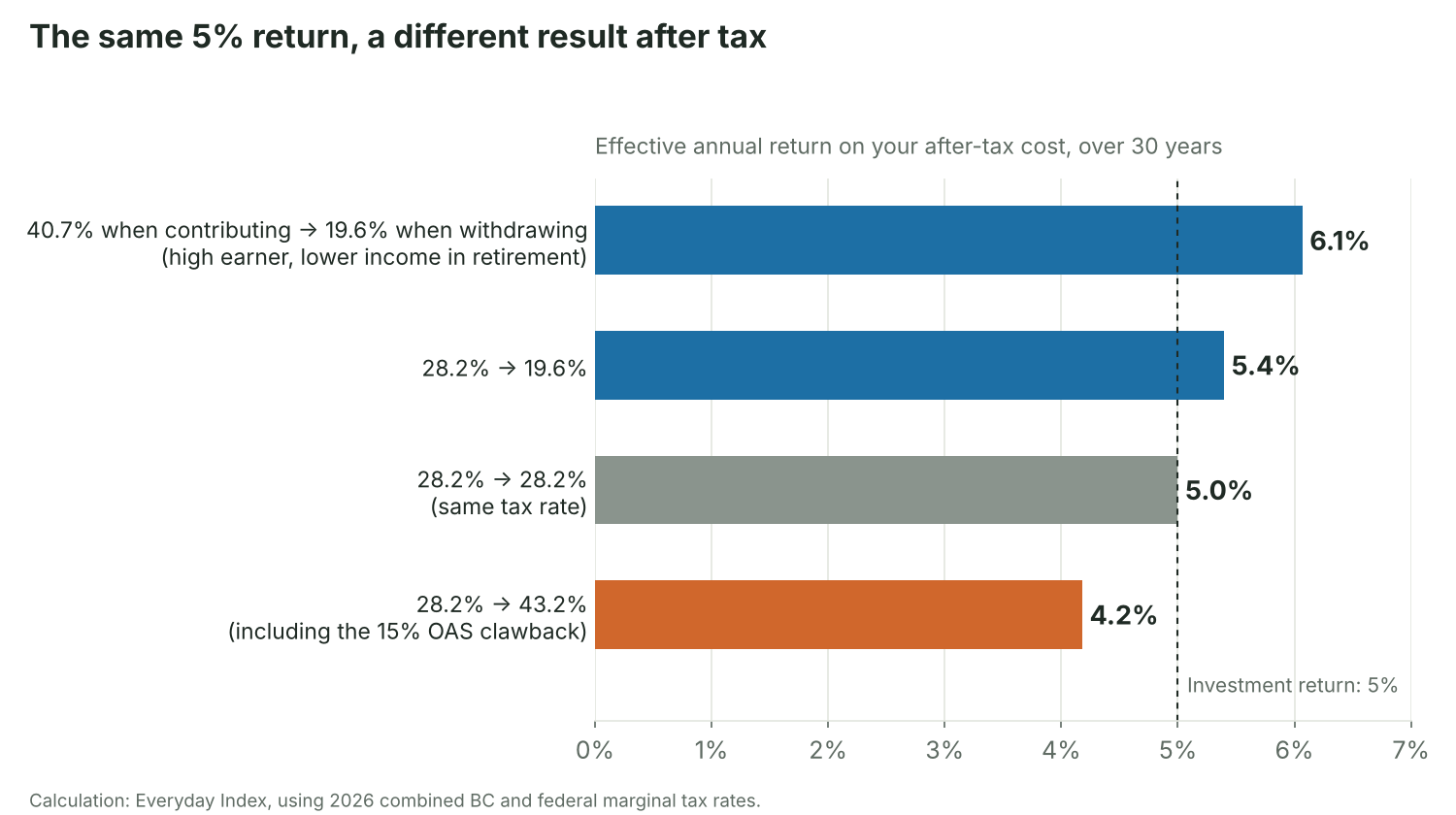
This calculation takes the $10,000 contribution, subtracts the $2,820 tax saving and treats the remaining $7,180 as the real cost. In other words, it compares $10,000 in an RRSP with $7,180 in a TFSA at the same after-tax cost. If you reinvest the refund, that extra investment, and the money behind it, has to be included in the comparison too.
The deduction can also be worth more than the tax rate alone suggests. Because it lowers your net income, it can increase income-tested benefits such as the Canada Child Benefit.
Taking money out
There's no annual limit on regular RRSP withdrawals, but three things apply.
Tax is withheld at the time: 10% on amounts up to $5,000, 20% from $5,001 to $15,000, and 30% above $15,000 (outside Quebec). This is a prepayment, not the final tax. The full withdrawal is added to your income for the year and taxed at your marginal rate when you file.
The room is gone. Contribution room used for a withdrawn amount does not come back.
By December 31 of the year you turn 71, an RRSP must be converted to a RRIF or an annuity, or cashed out. A RRIF has minimum withdrawals each year, starting the year after the RRIF is opened. The minimum is 5.28% of the balance at 71 and rises with age.
Two programs let you borrow from your own RRSP without tax, as long as you repay it:
Home Buyers' Plan: up to $60,000 for a first home (for withdrawals after April 16, 2024), repaid over 15 years. Repayments normally start in the second year after the withdrawal; for first withdrawals from 2022 to 2028, the start is deferred to the fifth year, so a first withdrawal in 2026 is first repaid in 2031. The extension to 2028 was passed into law in June 2026.
Lifelong Learning Plan: up to $10,000 a year and $20,000 in total for full-time education, repaid over 10 years.
Missed repayments are added to your taxable income for that year.
Starting early vs starting late
To see how much timing matters, let's compare three people. Each contributes $6,000 at the end of every year, which fits within the room of anyone earning about $34,000 or more, earns 5% a year, and checks the balance at 65.
The first contributes every year from 25 to 65, 40 years in all. The second contributes from 25 to 40 and then stops, leaving the money to grow. The third starts at 40 and contributes until 65.
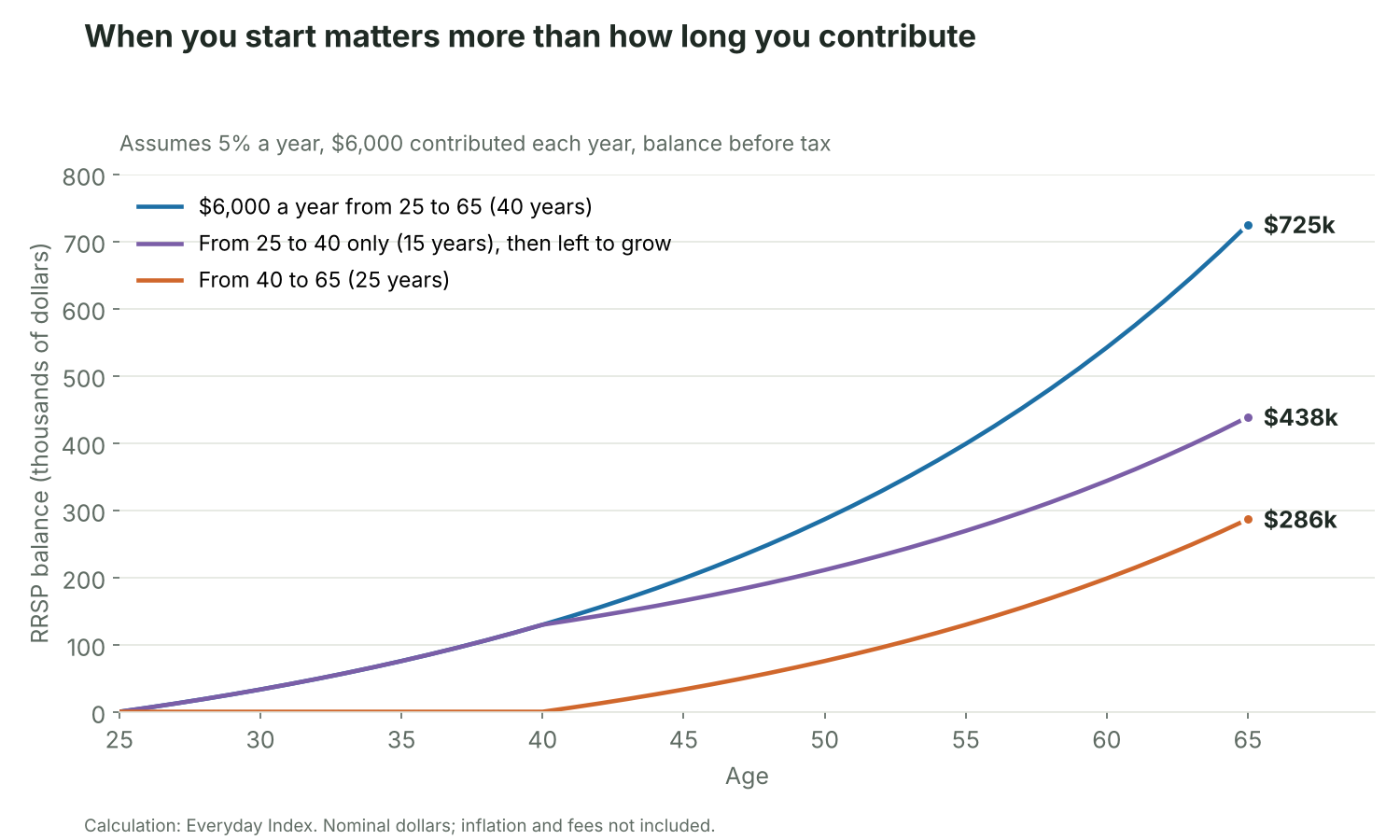
The first ends with $724,799 from $240,000 of contributions. The second, who stopped at 40, ends with $438,436 from just $90,000. The third ends with $286,363 from $150,000.
The second person put in $60,000 less than the third, yet ends up with about $152,000 more. The 15 years of early contributions keep compounding long after the payments stop.
For the late starter to catch up with the first person by 65, they would need to contribute about $15,186 a year from 40, two and a half times as much. If they have enough unused room from their twenties and thirties, the RRSP will let them do that. What it can't give back is the time.
These are nominal figures. Adjusted for 2% inflation over the 40 years from age 25, the first person's $724,799 would be worth about $328,000 in the money of the year they started. They're also before tax: the money is taxed as it's withdrawn.
What the investments earn, and what fees take
Everything above assumes the money earns 5% a year. What you actually earn depends on what's inside the RRSP. An RRSP is an account, not an investment: it can hold savings deposits, GICs, bonds, mutual funds, ETFs or stocks. As illustrations, not forecasts, I used 3% for something like GICs and 7% for a portfolio weighted toward stocks, which can swing much more from year to year.
| Annual return | 25 to 65 (40 years) | 25 to 40 only | 40 to 65 (25 years) |
|---|---|---|---|
| 3% | $452,408 | $233,652 | $218,756 |
| 5% | $724,799 | $438,436 | $286,363 |
| 7% | $1,197,811 | $818,316 | $379,494 |
Even at 3%, the person who stopped at 40 still ends up ahead of the one who started at 40. The higher the return, the more starting early is worth.
Fees work the same way, in reverse. Canadian mutual funds have long been among the more expensive in the world: a 2019 Morningstar study put the median management expense ratio (MER) for Canadian equity funds at 1.98% a year. Lower-cost options such as ETFs are widely available today, but the figure shows how much fees can matter. A 1.5% fee turns a 5% return into 3.5%. For the person contributing from 25 to 65, that cuts the balance at 65 from $724,799 to $507,302, about $217,000 less, close to the $240,000 they put in.
There's also the tax you don't pay along the way. Inside an RRSP or a TFSA, interest, dividends and capital gains aren't taxed each year. In an ordinary taxable account, interest is taxed every year at your full marginal rate. At 28.2%, a 5% interest return becomes about 3.59% after tax. The same $7,180 would grow to $20,685 in 30 years, compared with $31,032 in a TFSA and $34,748 after tax in the RRSP example above. Capital gains and Canadian dividends are taxed more lightly than interest, so the gap is smaller for stock investments, but it doesn't disappear.
What this means
An RRSP isn't a product that earns a return by itself. It's a way of moving income from a higher-tax year to a lower-tax one. That makes the useful questions personal ones. What's your marginal rate now? What is it likely to be when you withdraw? And will you reinvest the refund?
For someone earning below about $50,000, the refund rate is relatively low, and a TFSA can be just as good, with more flexibility. For someone in the 38% to 46% range who expects a modest retirement income, the RRSP's after-tax return can beat the investments inside it. The longer money is invested, the more compounding does. But with an RRSP, the tax rate at the time of the deduction matters too, so think of when to start investing and when to use the deduction as separate decisions. You can contribute early and carry the deduction forward to a higher-income year. And don't forget that fees compound just as surely as returns do.
This article is general information, not financial or tax advice. Rules and rates change; check your own situation with CRA or a qualified advisor.