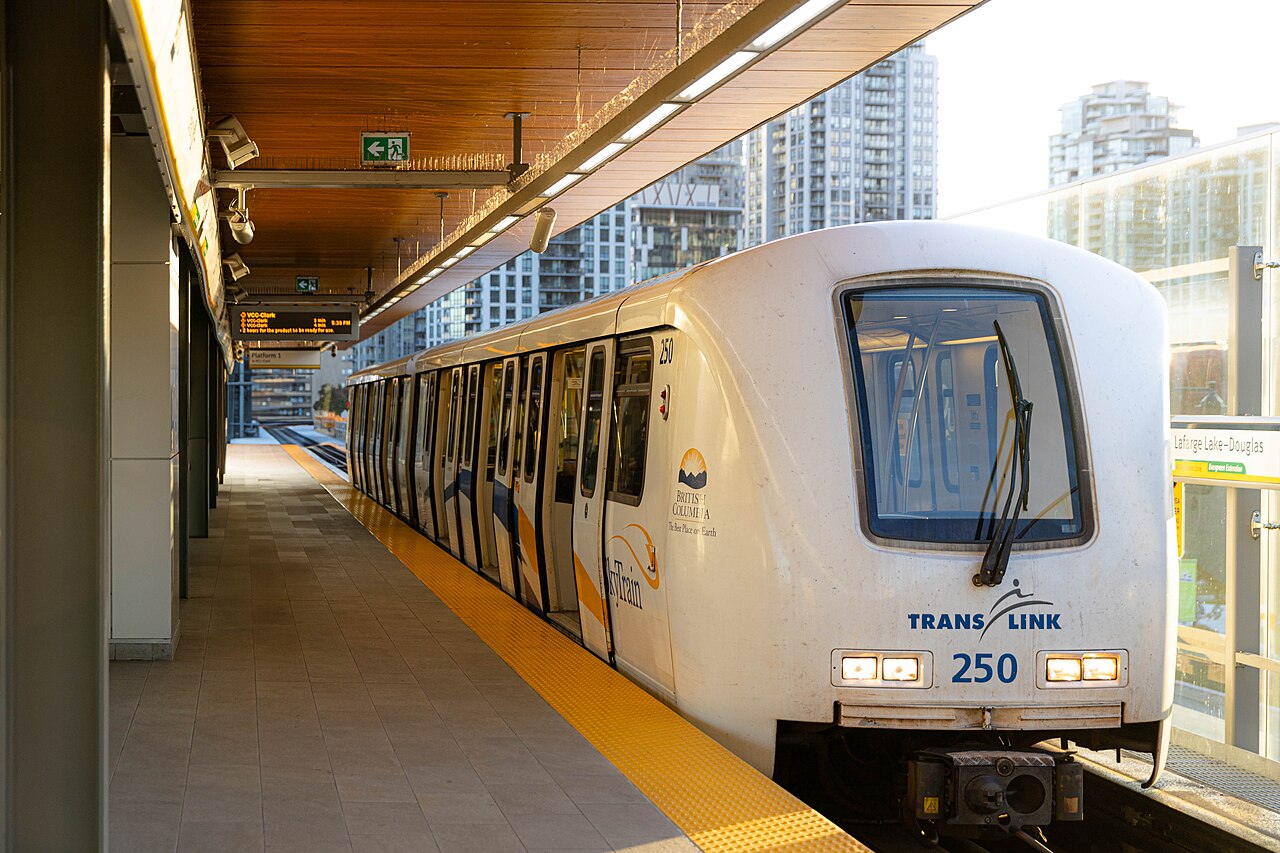
Every time I hear about a SkyTrain extension, my first thought is, “That won’t be finished for years.”
The Broadway Subway was originally scheduled to open in 2025. It has since been delayed twice and is now targeting fall 2027. Its budget has also grown, from about $2.83 billion in 2018 to about $2.954 billion. The Surrey–Langley extension has seen its cost swell from about $4 billion to about $6 billion, with the expected opening pushed from late 2028 to late 2029.
So are Vancouver’s rail projects truly exceptional in how long they take and how much they cost? Comparing them with subway extensions in Japan — including Tokyo and Fukuoka — and with Toronto, Canada’s largest city, reveals something unexpected: the Broadway Subway’s cost per kilometre is close to the two Tokyo extensions.
Why was the Broadway Subway delayed?
The Broadway Subway extends the Millennium Line about 5.7 km from VCC–Clark Station to Arbutus, adding six new underground stations. The contractor began work in fall 2020, and the line is now scheduled to open in fall 2027 — about seven years from the start of construction to opening day.
In 2022, a five-week strike by concrete workers, among other factors, delayed the start of tunnel boring, and the opening was moved to early 2026. Then in 2024, relocating underground utilities and installing temporary decking — needed to build stations while keeping traffic moving — took longer than expected, pushing the opening to fall 2027.
In May 2026, test trains began running on the new tracks. Even once the tunnels and stations are complete, trains must run and the entire system must be verified before the line can open.
Surrey–Langley: costs driven up by inflation
The Surrey–Langley line is a roughly 16 km extension built mostly as an elevated guideway along the Fraser Highway. The provincial government has said that inflation, rising material costs, supply-chain pressures and labour shortages pushed up the prices in contractors’ bids. The budget, about $4 billion as of 2022, was revised to about $6 billion in 2024, and the expected opening moved from late 2028 to late 2029.
The transportation minister at the time said construction materials had risen by about 60%, labour by about 20%, and shipping costs for parts from overseas by more than 100%. Because this line is mostly elevated, its construction conditions differ from those of the underground Broadway Subway.
Tokyo’s extensions: more than 10 years from start to finish
In Tokyo, work is underway to extend the Yurakucho Line about 4.8 km from Toyosu to Sumiyoshi, and the Namboku Line about 2.5 km from Shirokane-Takanawa to Shinagawa. Tokyo Metro began construction on both in November 2024 and is targeting an opening in the mid-2030s — more than 10 years from the start of construction.
Why does it take so long, even in Tokyo? One likely factor is the need to connect with, and work around, existing lines and underground structures. The Yurakucho Line extension will branch off at Toyosu, pass through Toyocho, and run to Sumiyoshi, where it will connect with the Hanzomon Line and the Toei Shinjuku Line. The Namboku Line extension involves building a structure directly beneath the operating Namboku Line so the new branch can split off toward Shinagawa.
Tokyo Metro’s construction plans include upgrades to existing stations and work beneath lines that remain in service. Around Shinagawa Station, construction of the Chuo Shinkansen maglev station and large-scale redevelopment are also underway, requiring coordination with those projects as well. These factors don’t account for the entire 10-plus-year timeline, but they show that the job involves far more than simply boring a tunnel.
Preparation before construction also took time. Both lines received railway business approval in March 2022, and construction began in November 2024 — more than two and a half years from approval to the start of work.
Projects in Japan don’t always go according to plan, either. The Fukuoka City Subway Nanakuma Line extension from Tenjin-minami to Hakata is about 1.4 km long. Main construction began in fiscal 2013, with an opening originally targeted for fiscal 2020. But in 2016, a massive sinkhole opened in the road in front of Hakata Station. The opening slipped to March 2023, about 10 years after construction began, and the project cost rose from about 45 billion yen to about 58.7 billion yen.
The Broadway Subway has already been delayed twice. Even so, based on current published schedules, it is expected to open after a shorter construction period than Tokyo’s extensions.
Cost per kilometre: close to Tokyo’s two extensions
Dividing project cost by construction length gives the Broadway Subway a cost of about $518 million per kilometre. The two Tokyo extensions are about $464 million to $496 million per kilometre, a close range, while the Fukuoka extension is about $371 million. Japan’s projects vary, but Broadway is close to Tokyo’s two lines.
| Line | Length | Project cost | Cost per km | Construction start to opening |
|---|---|---|---|---|
| Broadway Subway | 5.7 km | approx. $2.954 billion | approx. $518 million | Fall 2020 – Fall 2027 (approx. 7 years) |
| Yurakucho Line extension (Toyosu–Sumiyoshi) | 4.8 km | approx. 269 billion yen | approx. 56.0 billion yen (approx. $496 million) | Nov. 2024 – mid-2030s (10+ years) |
| Namboku Line extension (Shirokane-Takanawa–Shinagawa) | 2.5 km | approx. 131 billion yen | approx. 52.4 billion yen (approx. $464 million) | Nov. 2024 – mid-2030s (10+ years) |
| Fukuoka Nanakuma Line extension (Tenjin-minami–Hakata) | approx. 1.4 km | approx. 58.7 billion yen | approx. 41.9 billion yen (approx. $371 million) | FY2013 – Mar. 2023 (approx. 10 years) |
Note: Tokyo distances and project costs are based on Ministry of Land, Infrastructure, Transport and Tourism documents; Nanakuma Line distance, cost and opening date are based on figures published by the Fukuoka City Subway. Tokyo opening dates are current targets and may change. Because the items included in project costs, the timing of estimates, construction methods and other conditions differ by line, this is not a strict like-for-like comparison. All yen figures were converted at the October 29, 2026 exchange rate (C$1 = approx. 112.9 yen) and are approximate. All dollar figures are in Canadian dollars unless otherwise noted.
But being close to Tokyo doesn’t mean “cheap”
Zoom out to the rest of the world, and the picture shifts. Alon Levy, a researcher with the Transit Costs Project, estimated that as of 2019, the global median cost of building an urban subway was under US$300 million per kilometre. Analyses have also found that Canada’s costs are lower than those of the U.S. and the U.K., but higher than almost everywhere else — closer to Germany and Japan. Countries such as Spain, Italy and France have built urban rail at lower cost than Canada.
That said, cross-country cost comparisons vary with line length, the share of the route underground, the number and size of stations, and what’s included in the cost. These figures can’t tell us exactly how much more the Broadway Subway costs than the global average. Japan’s own examples also vary: the two Tokyo extensions have higher costs per kilometre than the Fukuoka project. Countries such as Spain, Italy and France have built urban rail at lower cost than Canada.
Toronto: even longer timelines
Within Canada, the situation in Vancouver and Toronto is quite different. Construction on Toronto’s Eglinton Crosstown began in 2011, and passenger service started in February 2026 — about 15 years from groundbreaking to opening. As of 2016, it had been expected to enter service in September 2021. It is an LRT rather than a subway or SkyTrain, but it is still a useful reference point for urban rail timelines.
Toronto’s Ontario Line, now under construction, is a new subway line about 15.6 km long. The 2019 provincial budget estimated its construction cost at about $10.9 billion. In August 2026, Metrolinx’s CEO said the current cost was about $34 billion — but this is not a final figure, and the value of the remaining contracts has yet to be determined. Moreover, the currently published cost includes not only construction but also 30 years of operations and maintenance, land acquisition and more. Because its scope differs from the 2019 construction estimate, it would be misleading to simply say the cost has “tripled.”
On timelines, the Eglinton Crosstown took far longer than the Broadway Subway’s current schedule. The Ontario Line’s cost, on the other hand, is calculated on a different basis and can’t be compared directly with Vancouver’s project costs.
The Canada Line was built fast — at a different price
Vancouver’s Canada Line broke ground in November 2005 and opened on August 17, 2009. The government of the day announced that the roughly 19 km line had been completed in under four years, about three and a half months ahead of schedule and on budget. The deadline of the upcoming Winter Olympics was another reason to build quickly.
One of the methods behind that speed was “cut-and-cover” construction, which involved digging up Cambie Street and laying the line beneath it. During construction, businesses along the street saw major disruption to their operations and customer access. The owner of a maternity store on Cambie Street sued for damages and, in 2009, the B.C. Supreme Court (the province’s trial court) awarded about $600,000. But in 2011, the B.C. Court of Appeal overturned that ruling, and the Supreme Court of Canada declined to hear an appeal. In the end, no damages were awarded in the case.
The Canada Line experience went on to shape the choice of construction method for the Broadway Subway. B.C.’s transportation minister explained in the legislature that, given how severely the Cambie Street work had disrupted businesses and pedestrians, the government did not want to repeat cut-and-cover construction. On the Broadway Subway, much of the route outside the station sites is being dug with tunnel boring machines, keeping traffic and pedestrians moving during construction.
Even so, the impact on the neighbourhood hasn’t disappeared. Build fast, or minimize disruption to the city during construction? The choice of method affects timelines, costs and daily life along the route in different ways.
Is SkyTrain actually doing well?
In terms of construction time, the Broadway Subway is expected to take less time than Tokyo’s extensions, and less than the roughly 15 years of Toronto’s Eglinton Crosstown. Even after two delays, at least based on current published schedules, it is aiming to open sooner than the other lines compared here. If anything, the Broadway Subway may actually be holding its own. The final verdict, of course, will have to wait until it actually opens.
On cost, however, the Broadway Subway is close to Tokyo’s two extensions but more expensive than Fukuoka’s — and by global standards, far from cheap. Construction timelines and costs depend not only on inflation, but also on connections with existing lines, construction methods, and how much disruption to the city a project tries to avoid.
Perhaps it feels “slow” because news of delays stands out, while how long major urban rail projects actually take is much harder to see. The next time a headline announces “another delay,” it’s worth looking beyond how many years the project has slipped — and asking what construction method was chosen, and how the project is trying to limit its impact on the city during construction.