The second layer of retirement income
Canada's retirement income is often described in three layers. The first is OAS, paid from general tax revenue. The second is the CPP, based on what you paid in while working. The third is your own savings, such as an RRSP or a workplace pension. Almost everyone who works in Canada outside Quebec pays into the CPP; Quebec has its own plan, the QPP.
To qualify for a CPP retirement pension, you need just one valid contribution. There's no 10-year minimum like there is for OAS. Instead, the amount depends on your record of contributions. The CPP also pays disability and survivor benefits, but this article covers the retirement pension.
What you pay in 2026
Contributions are taken from your pay automatically, and your employer pays the same amount. In 2026, you pay 5.95% on earnings between $3,500 and $74,600, the year's maximum pensionable earnings (YMPE). Since 2024, there's also a second contribution, CPP2, of 4% on earnings between $74,600 and $85,000, the year's additional maximum pensionable earnings (YAMPE).
| Who pays | Rate | Maximum for the year |
|---|---|---|
| Employee (employer pays the same) | 5.95% | $4,230.45 |
| Employee CPP2 (employer pays the same) | 4% | $416 |
| Self-employed | 11.9% | $8,460.90 |
| Self-employed CPP2 | 8% | $832 |
Self-employed people pay both the employee and the employer share, so their rate is twice as high.
How the amount is calculated
The CPP retirement pension has two parts: the base component, and the enhanced component that started in 2019.
The base component depends on your average earnings over your contributory period, from age 18 until your pension starts. To get the full amount, you need earnings at or above the YMPE for most of that period. You can drop your lowest-earning months, up to 17% of the period, from the calculation. If you start at 65, that's 17% of the 47 years from 18 to 65, or about 8 years. This allows for time spent in school or out of work.
The enhanced component builds up from the extra contributions you've paid since 2019. It came in two stages: the first was phased in from 2019 to 2023, and the second, matching CPP2, began in 2024. The CPP used to be designed to replace a quarter of your average earnings. Once the enhancement is fully built up, it will replace a third of earnings from 2019 onward.
The enhanced component uses your best 40 years, but 2026 is only its eighth year. Even people who've worked in Canada for decades can't yet receive the full enhancement. For people retiring now, it's still a small share of the pension.
For someone starting at 65 in January 2026, the maximum pension is $1,507.65 a month. Because of the enhancement, the maximum can rise slightly from month to month. Few people get the maximum, though. The average for new pensioners starting at 65 in July 2026 was $858.34 a month.
So how much do you need to earn to get the maximum? For the base component, you need earnings at or above each year's YMPE for about 39 of the 47 years from 18 to 65, once the roughly 8 years are dropped. The YMPE rises every year. It's $74,600 in 2026, but it was $47,200 in 2010, $37,600 in 2000 and $28,900 in 1990. What matters is reaching each year's limit, so it doesn't mean earning $70,000 or more in today's dollars for 39 years.
For the enhanced component, you get the most for a year if you earned at least the YMPE since 2019, and at least the YAMPE ($85,000 in 2026) since 2024. In other words, at 2026 amounts, earning $85,000 or more maxes out your CPP contributions and brings your future pension close to the maximum. Earning more than that doesn't increase your CPP.
| Part | Annual limit | Maximum reached at earnings of |
|---|---|---|
| Base component | YMPE | $74,600 in 2026 ($47,200 in 2010, $37,600 in 2000) |
| Enhanced, first stage | YMPE | $74,600 in 2026 |
| Enhanced, second stage (CPP2) | YAMPE | $85,000 in 2026 |
Only people who've earned at or above the limit for most of their working lives get the full $1,507.65. More than 8 low-earning years, or many years below the limit, bring the amount down. That's why the average is less than 60% of the maximum.
There's also a child-rearing provision, which can drop periods when you were caring for a child under 7. It isn't always applied automatically, so you may need to request it. And if you keep working after 65 without starting your pension, those earnings can replace earlier low-earning years.
How much difference the age you moved makes
For newcomers, the key point is that the period from 18 includes the years before you arrived. Those years count as zero not because you lived in Japan, but because there's no record of CPP contributions for them.
Here's roughly what share of the maximum base component you'd get, assuming you earned at least the YMPE every year from arrival to 65 and started your pension at 65. OAS is shown alongside for comparison.
| Age you moved | CPP base component (approx.) | OAS |
|---|---|---|
| 25 or younger | 100% | 100% |
| 30 | About 90% | 87.5% |
| 35 | About 77% | 75% |
| 40 | About 64% | 62.5% |
| 45 | About 51% | 50% |
| 55 | About 26% | 25% |
The CPP shares are a simplified estimate of the base component. They drop about 8 of the 47 years from 18 to 65 and assume earnings at or above each year's YMPE after arrival. They leave out the enhanced component and special provisions such as child-rearing, so your actual amount will differ.
The CPP comes out slightly higher because up to 8 low years can be dropped. Even so, most of the years before you arrived remain. For someone who moved at 35, about 8 of the 17 zero years can be dropped, and the other 9 or so keep pulling the average down. Any years below the YMPE lower the share further.
The enhanced component is smaller too if you've paid the extra contributions for fewer years. Either way, the years you worked and paid in, in Canada, drive the amount. The later you arrived, the more it's worth working past 65 without starting your pension, so those earnings replace low years. Someone who moved at 55 has about 26% of the base component at 65, but a few more years of earnings can replace some of the zero years.
Start at 60, 65 or 70?
You can start your CPP at any age from 60 to 70. Starting before 65 reduces it by 0.6% for each month, so starting at 60 pays 36% less. Starting after 65 increases it by 0.7% for each month, so starting at 70 pays 42% more. That's a bigger increase than the 0.6% for OAS, and the change lasts for life.
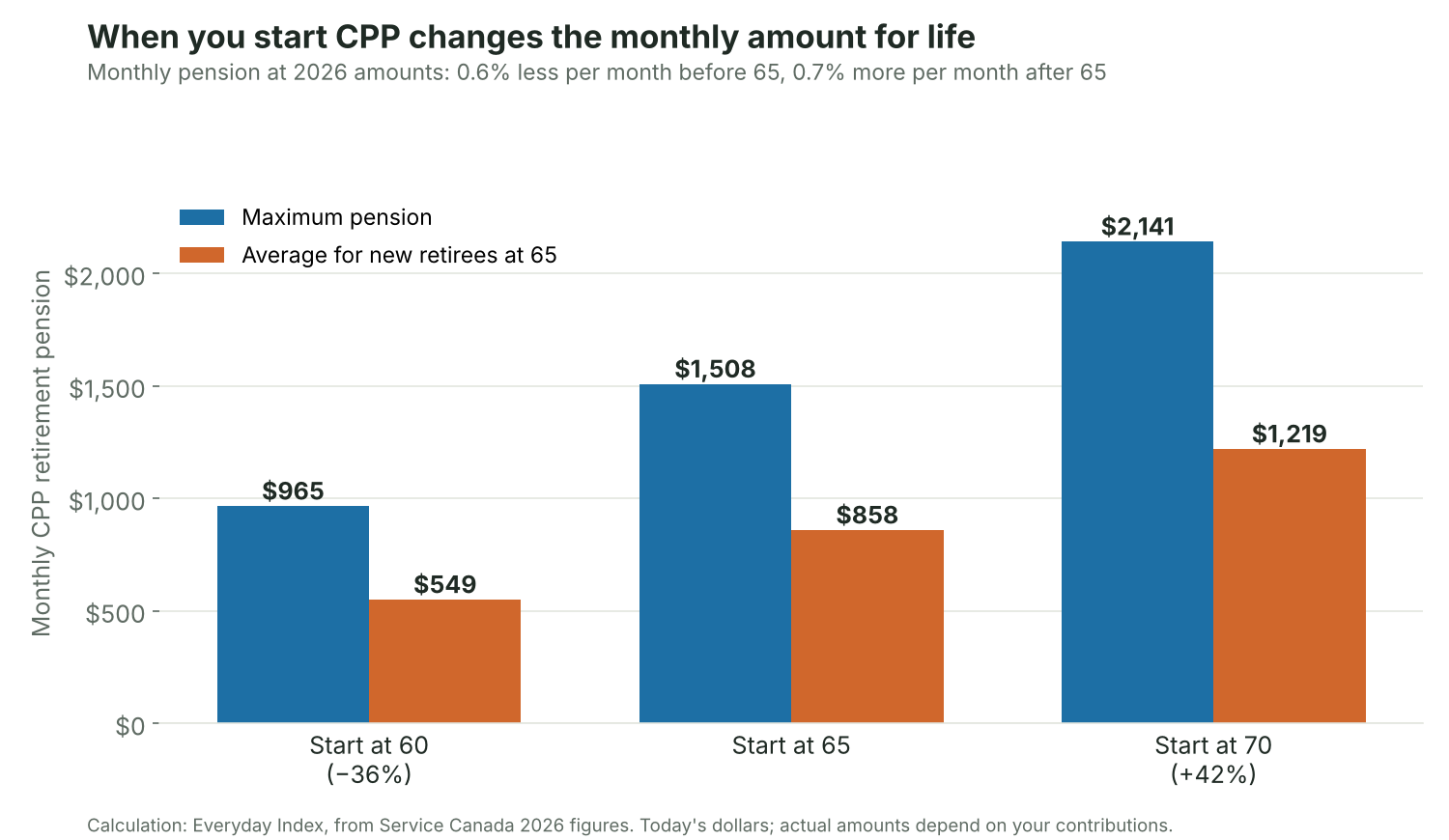
This compares the same contribution record with different start ages. Based on the maximum at 65 ($1,507.65 a month), starting at 60 pays about $965 a month and starting at 70 about $2,141. Based on the average at 65 ($858.34 a month), it's about $549 at 60 and about $1,219 at 70. These figures apply the percentages to the 65 amounts; they aren't the average pensions of people who actually started at 60 or 70. Starting at 60 also means fewer years of contributions, which can lower the amount a little more.
A useful guide is the break-even point. Using the same base amount and percentages, and ignoring differences in contribution records, taxes, inflation adjustments and investment returns, someone who starts at 70 catches up with someone who started at 65 at about 82. Someone who starts at 65 catches up with someone who started at 60 at about 74. Live longer than that, and starting later pays more in total.
Starting early can still make sense, for example if your health is poor or you need the income now. If you work while receiving the CPP between 60 and 65, you must keep contributing, and those contributions add a post-retirement benefit to your pension from the following year. Between 65 and 70, you can choose to stop contributing.
The CPP doesn't start automatically. You have to apply. If you apply after 65, your payments can go back up to 11 months.
Salary or dividends for business owners
If you pay yourself from your own corporation, choosing salary or dividends changes your CPP. Salary is subject to CPP contributions, and you pay both the employer and employee share. On a 2026 salary of $74,600 or more, that's $8,460.90 combined, or up to $9,292.90 including CPP2.
Dividends aren't subject to CPP contributions. You keep more now, but your future CPP doesn't grow. Dividends also don't create RRSP room; only salary does. Paid only in dividends, you add zero years to your CPP record and no new RRSP room. Whether you see the contributions as a cost or as retirement savings shapes the decision, and it's one many owners make with their accountant.
Check your own estimate
You can see your CPP record and estimate in My Service Canada Account (MSCA), including your Statement of Contributions and your estimated pension at different starting ages.
You can sign in with an Interac Sign-In Partner (your bank's online banking), a GCKey, or a provincial sign-in such as the BC Services Card in BC. The first time you register, you need to verify your identity, either through the Interac verification service or with a Personal Access Code (PAC). If you've already applied for CPP or OAS, your PAC was mailed to you. Multi-factor authentication is mandatory.
It's worth checking early for any gaps in your record. Enter your estimated monthly CPP in the "Expected CPP pension" box of our OAS calculator to see your OAS and CPP together.
Can years in Japan count?
Under the Canada–Japan social security agreement, your years in Japan's public pension can help you qualify for CPP benefits. But since one valid contribution is enough for a CPP retirement pension, the agreement mainly matters for disability and survivor benefits. The amount is still based only on your contributions in Canada.
For OAS, Japanese periods can also help you meet the 10-year residence minimum, though they don't increase the amount. We covered that in our OAS article.
The agreement works the other way too. Japan's old-age basic pension requires at least 10 years of coverage, and years you paid into the CPP can count toward that. Japan then pays its own pension, separately, based on your Japanese years.
If a Japanese employer sends you to work in Canada and the assignment isn't expected to last more than 5 years, you generally stay in Japan's pension only and don't pay into the CPP. Those years won't appear on your CPP record, which is worth keeping in mind if you end up staying.
Taxes and inflation
The CPP counts as taxable income. It's adjusted for inflation every January. Unlike OAS, there's no clawback on the CPP itself, but CPP income counts toward the income used to calculate the OAS clawback.
For newcomers, it comes down to the years you worked in Canada
For people who grew up in Canada, the CPP mostly reflects how long they worked and what they earned. For people who moved here as adults, the years before arriving are part of the period from 18, and they show up in the amount. Up to about 8 years can be dropped; beyond that, the zeros stay.
The later you arrived, the more it matters whether you work past 65 to replace low years, or delay your pension to add 0.7% a month. A good first step is to check your record and estimate in MSCA.
This article is general information, not financial or tax advice. Your actual CPP pension is decided by Service Canada; check your own situation in My Service Canada Account.