Same electricity, two bills
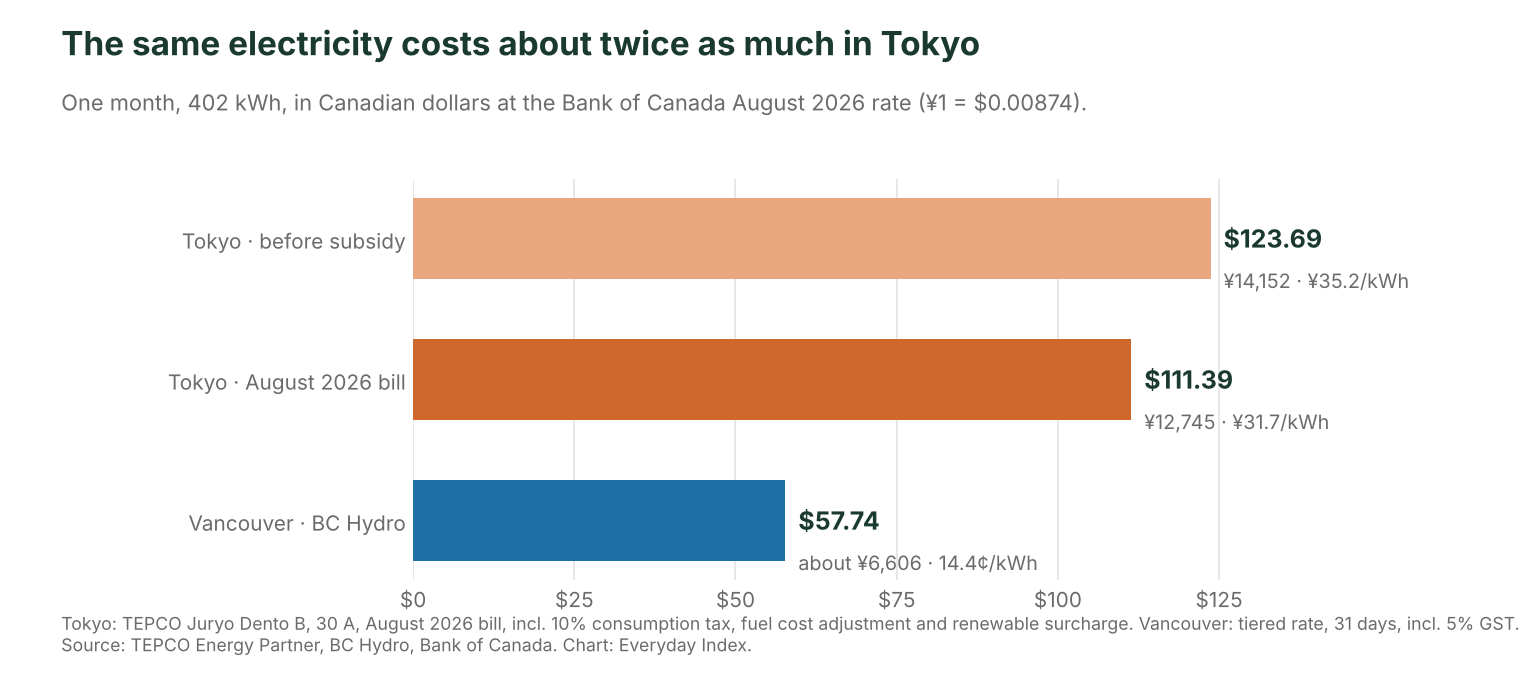
To compare like with like, I used 402 kWh for one month, the usage the Tokyo Metropolitan Government uses for its electricity price survey.
In Vancouver, on BC Hydro's tiered rate, a 31-day month at 402 kWh stays entirely in Tier 1: a basic charge of $7.27 and an energy charge of $47.72, plus 5% GST, for $57.74. That's about 14.4 cents per kWh. (A Metro Vancouver bill would also show the transit levy and the deferral account rate rider; together they add about a dollar.)
In Tokyo, on TEPCO's standard Juryo Dento B plan with a 30-amp contract, the same 402 kWh on the August 2026 bill comes to about ¥12,745, or $111.39 at the Bank of Canada's August 2026 exchange rate. Without a temporary government subsidy, it would have been ¥14,152, or $123.69. Either way, it's close to double.
The Tokyo government's own price survey, which our Canada vs Japan page uses, puts 402 kWh at ¥13,368 for August 2026. The difference from my calculation likely reflects the survey's contract and timing assumptions, but the conclusion is the same.
What's inside a Tokyo bill
A TEPCO bill is built a little differently from a BC Hydro one.
Basic charge (30 A): ¥935
Energy charge: 29.80 yen per kWh up to 120 kWh, 36.40 yen up to 300 kWh, and 40.49 yen above that, so ¥14,258 for 402 kWh
Fuel cost adjustment: −6.77 yen per kWh, or −¥2,722
Government subsidy for July use: −3.50 yen per kWh, or −¥1,407
Renewable energy surcharge: 4.18 yen per kWh, or ¥1,680
The 10% consumption tax is already included in those rates.
Two things stand out. First, Japan's energy charge rises with use, like BC's tiers, but the steps start much higher: Tokyo's cheapest kWh, at 29.80 yen or about 26 cents, costs nearly twice as much as BC's most expensive one (14.08 cents). Second, the fuel cost adjustment is negative. That doesn't mean fuel is cheap. TEPCO's base rates were set in 2023, when fuel was expensive, and assume a fuel price to match, so the cost of imported fuel is already built into the per-kWh rate. The adjustment only corrects for how far actual fuel costs have moved from that assumption.
Reason 1: Japan runs on imported fuel
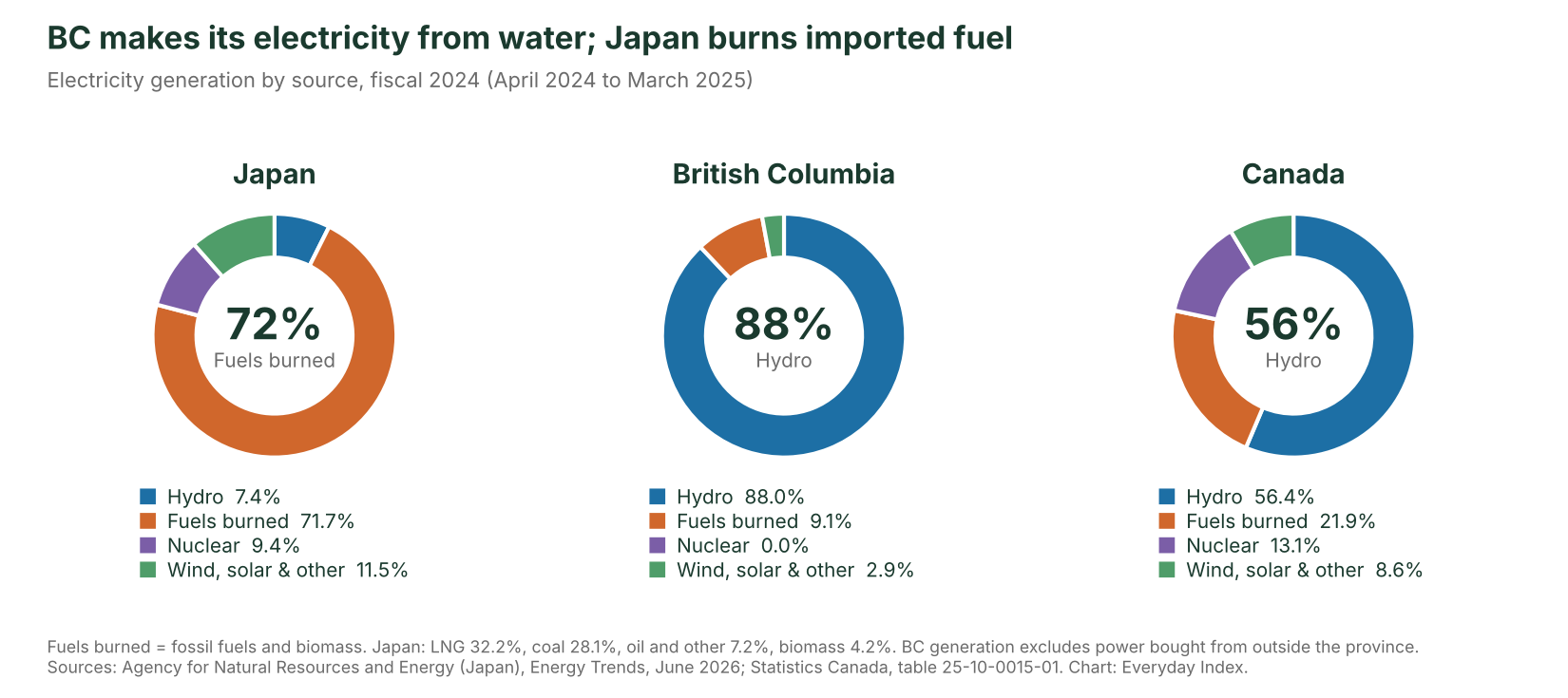
In fiscal 2024 (April 2024 to March 2025), fossil fuels generated 67.5% of Japan's electricity: liquefied natural gas (LNG) 32.2%, coal 28.1%, and oil and other fuels 7.2%. Almost all of it is imported, and Japan's overall energy self-sufficiency is only 16.3%.
That means every kWh carries the cost of buying fuel on world markets, shipping it, and, for LNG, cooling it to −162°C to transport it. It's also why Japanese bills react so strongly to events like the 2022 energy crisis.
The weak yen cuts both ways
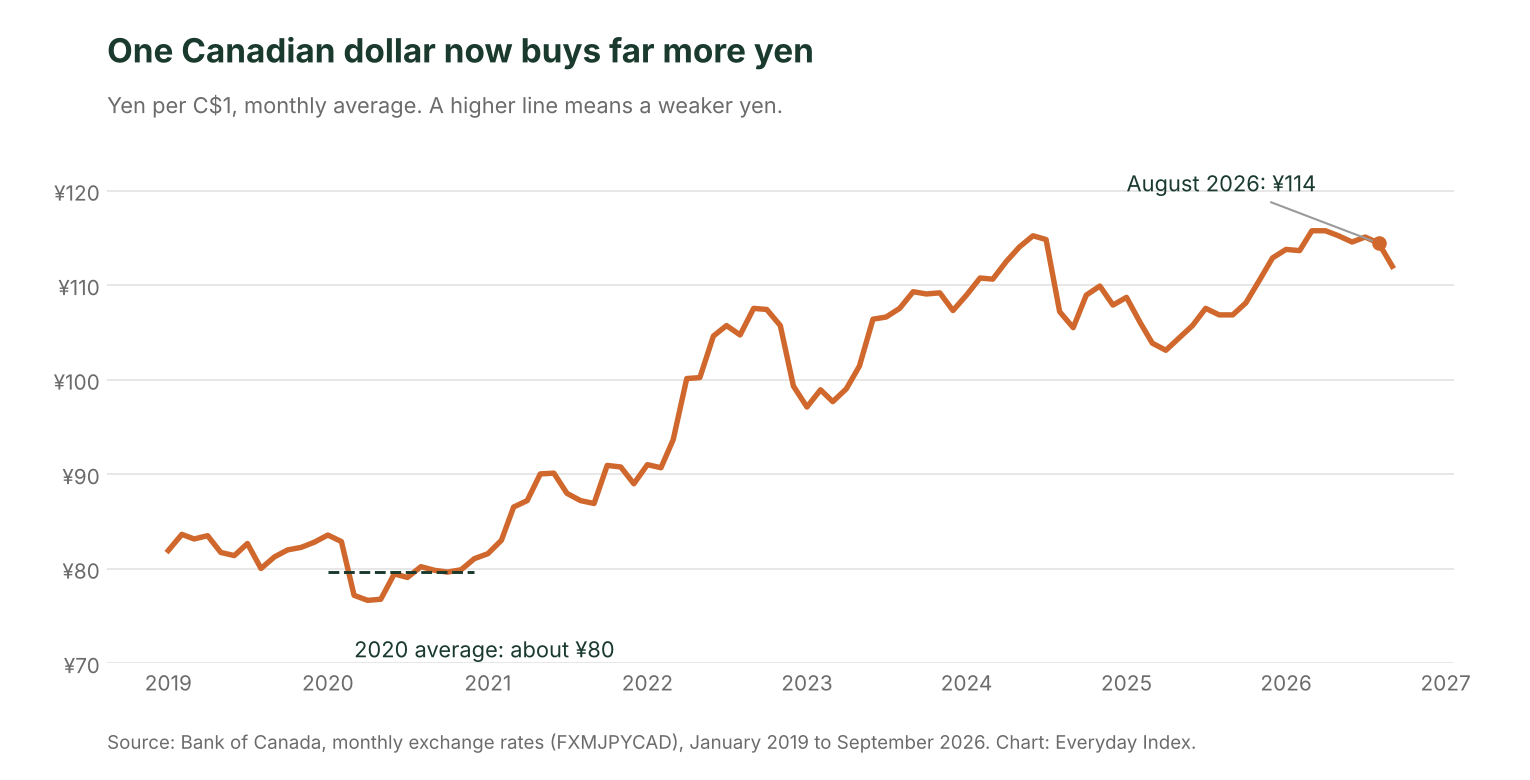
The yen has fallen sharply. In 2020, one Canadian dollar bought about 80 yen on average; in August 2026 it bought about 114. Measured in Canadian dollars, the yen has lost roughly 30% of its value.
For households in Japan, that makes electricity more expensive. LNG, coal and oil are bought in US dollars, so a weaker yen means paying more yen for the same shipment, and that flows into bills through the fuel cost adjustment and future rate changes.
For this comparison, it works the other way. Because I convert yen into Canadian dollars, a weaker yen makes Tokyo's bill look cheaper. At 2020's average exchange rate, the same ¥12,745 bill would come to about $160, or 2.8 times the Vancouver bill instead of 1.9. In other words, the gap in what Japanese households actually pay hasn't narrowed. It's the currency that makes it look smaller.
Reason 2: BC runs on water it already has
BC's electricity comes mostly from hydro. In the same fiscal year, hydro produced 88% of the electricity generated in the province, according to Statistics Canada. Water costs nothing to burn, and BC Hydro's big dams, mostly built between the 1960s and the 1980s, were paid for long ago.
So BC's price is mostly the cost of maintaining and expanding the system, not the cost of fuel. That's also why BC's main price risk is the weather rather than world fuel markets. In dry years, BC has to buy power from outside the province, as it did in 2023/24. I covered that in the previous article.
Reason 3: the renewable energy surcharge
Since 2012, Japan has paid for renewable power through a feed-in tariff, with the cost spread across every household's bill. For May 2026 to April 2027, the surcharge is 4.18 yen per kWh. At 402 kWh, that's ¥1,680 a month, about 13% of the Tokyo bill.
BC Hydro bills don't have an equivalent line. The cost of BC Hydro's power purchases, including from independent renewable producers, sits inside the regular rates.
Would nuclear power bring Japan's prices down?
Possibly, but slowly and only partly. Once a reactor is built, its fuel is cheap compared with LNG or coal. The expensive part is building it, upgrading it to post-Fukushima safety standards, and keeping it running.
After 2011 most of Japan's reactors were shut down, and nuclear generated 9.4% of Japan's electricity in fiscal 2024. Most of the restarted reactors are in western Japan. Unit 6 at the Kashiwazaki-Kariwa plant in Niigata restarted on January 21, 2026, and began commercial operation on April 16. It's the first TEPCO reactor to run since the Fukushima accident.
More nuclear power means less imported fuel, which should ease costs over time. Whether and when that shows up on household bills, though, depends on how the utility and the government set rates, not just on fuel savings.
What about nuclear power in Canada?
Canada does use nuclear power, just not in BC. In 2024, nuclear plants generated 80.7 million MWh, about 13% of Canada's electricity. Most of it is in Ontario, where nuclear supplied 48.5% of the province's electricity in 2024. New Brunswick also has a reactor.
BC is different by law. The Clean Energy Act sets the goal of meeting BC's energy objectives "without the use of nuclear power". So BC's low prices have nothing to do with nuclear. They come from geography: big rivers, mountains and dams built decades ago.
What this means
In BC, you can roughly predict next year's electricity bill. Rates change each April, and the increase is announced in advance. Not so in Japan. Fuel prices, the yen and whether a subsidy is in place all move the bill from month to month, even if you use power the same way. And it starts from about twice BC's level.
That stability depends on water. A run of dry years means buying more power from outside the province, and that would leave BC's bills more exposed to outside markets, much as Japan's are.
You can compare more everyday prices on our Canada vs Japan page, and try your own BC Hydro numbers in the bill calculator on the Electricity page.